Archívy autora: ambient-cc

Augmented reality and Creativity

Augmented reality is a combination of the real world with a computer-generated reality using a software, imagery and a camera of an actually used device. The camera captures a real image of the physical world, the device will afterwards analyze the imagery and cover it up using the augmented reality software, adding new image or video-footage on top of the original coverage of the physical world.

Another form the augmented reality technology is the digital storefront. A shop’s window looks regularly, until a person walks by or touches the glass. The window will then use an application, that enables the bystanders to see themselves playing the guitar, for example. One of the interesting examples would be an advertisement for a soft drink which aimed to present people waiting for public transport to experience something new (augmented reality, bus-stop, advert for Pesi Max (Jacob Kasternakes, 2014)). In a bus stop glass, the bystanders were able to see improbable events take place, and the events were synchronized with the real imagery of the street the bus stop was placed in.

This kind of campaigns can also have an environmental aspect. An interactive digital project called No more fish in the? (Project Ocean, 2011, online).) can experience an immersive adventure into the underwater scenery right from their streets and they can watch their fish grow and reproduce just after they donate money to the project.

In the aforementioned examples, augmented reality was partially independent from the concrete viewer (flying UFO in the streets or watching fish being added to an aquarium after a viewer’s action). Augmented reality can be moved even further in communication and be enriched by an interactive aspect – a screen can react to a viewer directly, making him an inherent part of the production. Interactive ambient marketing – bystanders are scanned and their visages are displayed dressed in Bennetton collections (Benetton Windows Interaction, 2012, online). Bennetton Firm’s advertising reacts to concrete viewers, making them a part of the screen, displaying them as dressed in the new Bennetton collection. The element of surprise is markant for marketing communication via utilizing holograms[1], as most consumers have not yet had this kind of experience before. Hologram communication bears the elements of experience and memorability („WWF Elephant” Hologram, Watson Imogen, 2018, online). In October 2018 in selected parts of London and Edinburgh, the World Wildlife Fund started a campaign connected to a petition demanding a full stop to illegal trading with wild animals, while also increasing awareness for the problema[2].

Bluecasting is a controversial example of digital technology and a place, where an ambient marketing message is placed. It is a combination of mobile marketing communication with an external media through Bluetooth, which enables transfer of content, advertisement included. The users are therefore able to receive content (even if they do not wish it) like maps, information about cultural sites and more. This technology raises questions connected to ethics and cyber-security. Propagation via bluecasting often happens without knowledge of the user, even though recently, regulations for this practice became a bit more severe. Transfer of data without knowledge and consent of users to their devices is called Bluespam (alternatively called Bluejacking[3]) (Marchini a Tebbutt, 2007). The Beacon[4] technology can be abused in a similar way to reach same results.

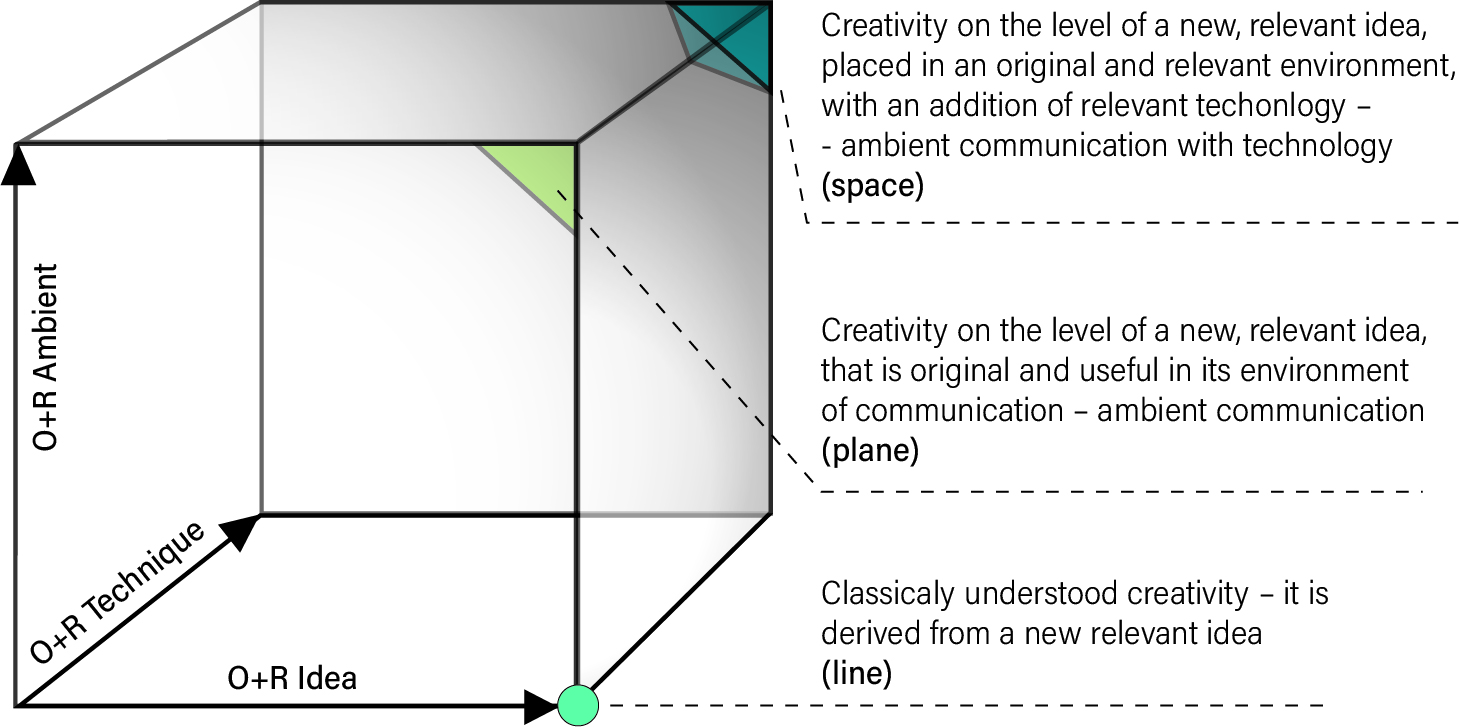
From these examples, we can deduce that thanks to the new technologies, the element of surprise and novelty have become necessary traits in ambient marketing communication and they prove creativity of new messages. Besides the first two attributes, new technologies contribute to saturation of usefulness and relevance as well. (We understand the element of surprise as a necessary aspect of creativity – Ji Han, Hanah Forbes, and Dirk Schaefer (2021)). We tried to synthesize and display the relations between all the attributes in the scheme No. 1 – this scheme follows up, elaborates on and further develops the ideas of previous authors.

Scheme No. 1: Levels of creativity of marketing communication from the point of important components of creativity with regard to new technologies and the place of ambient communication using this technology.

Legend: O = originality, novelty, unusualness, R = relevance, source: our own study.

Source: our own research

In the past, authors Roger M. Garrett (1987), Albert Rothenberga and Carl R. Hausman (1976), spoke of creativity as a vector of two basic components (aspects): originality (y axis), which would reach 45° angle with the highest possible creativity. This attitude was criticized, however, for values nearing 0° could also depict high or maximum creativity. The author therefore offered an alternative, in which the space between the lines was separated into four quadrants – and so creativity was represented only in the last one, where maximum originality meets maximum usefulness. On the other hand, in the remaining quadrants one or both of the components are under-represented, and therefore those situations are not considered to be creativity, but rather insignificant displays of failing products – with low originality or/and usefulness. Useful, but not new ideas, would not be considered nor original, nor creative. The same principle would go for bizarre new ideas that do not have any use, despite their novelty.

According to Ji Han, Hanah Forbes, and Dirk Schaefer (2021, s. 294), these relations could be expressed by the following equation:

Creativity (C) = Novelty (N) x Usefulness (U),

In other words, if a marketing message does not reach sufficient value in both Novelty (N) and Usefulness (U), it cannot be considered creative.

On a higher level, creative ambient marketing communication uses unusual placement to further deepen its originality and usefulness. If it also uses new technology, it becomes even more developed. These inclusion create new connections in new, well-integrated ambient or guerilla marketing communication (ambitechmac, ev. guertechmac)[5], and thus it reaches new level – the final part of the 3D cubic model of our scheme.

[1] According to CAGR (Compound Annual Growth Rate). The holographic display market is expected to grow at a of 27.3% over the period (2021 – 2026). Source: shorturl.at/gjnMT

[2] The campaign yielded more than a hundred thousand signatures, raising awareness of trade with wild animals and the intertwined system of organized crime.

[3] Bluejacking is using the Bluetooth technology to send spam – for example contact cards, imagery and other content – to other people’s devices without their knowledge and/or consent. Receivers of these messages are unable to identify who they the message from.

[4] Beacons are micro-devices able to connect to smart devices via the Blueetoth Low Energy technology. Within limited range, Beacons are able to send data or activate certain functions in smart devices of other people.

[5] The term ambient combined with the information about use of new technologies for the needs of marketing and/or marketing communication

Non-traditional Creativity

Non-traditional ways of propagation of products, services and ideas use unusual expressions and techniques, aiming to create unique surprise and sensation. It also reaches for new technologies, including video-tech, virtual reality and the technology of augmented reality. At the same time, one of the common forms of guerilla marketing are original poster installations (often called stickers), which can contain logo, text or illustrated materials, but especially a QR code, which takes a user to a new digital space. These are often found in public transport, at building entrances, on traffic signs for pedestrians and elsewhere in public space which are known to be frequented by a high number of people daily.

Media, which are the carriers of the message, also use new technology. They act as a middling position and mediate interaction, activating the recipient. Technologies can improve sensory aspects of the message and so deepen the experience. Technologies that interact with environment are used as an integral part of modern communication with environment (Čábyová, 2009). Among these, Bluetooth and other wireless technologies can be counted, but also the technologies that utilize motion sensors and other forms of sensory tech.

A technical example of the combination of digital technology and reality is the beamvertising. Beamvertising is a static or animated messaged projected on walls using a projector. One of beamvertising forms is called 3D-projecting, which is considered to be one of the most advanced techniques. An animated image is projected on a wall while integrating all aspects of the building’s architecture into it. Thanks to this synergy, the projected message seems to be three-dimensional, as it works with the 3D space it is exposed in.

The same principle is applied in the video-mapping, alcohol Bacardi (Daniela Krautsack,
2011, online), where we see digital mapping of urban buildings, water video-mapping, auto BMW (JCDecaux, 2012, online)., where we can see the water video-mapping technique, which projects messages on a water wall.

The following examples show a case, in which video-projection and digital technologies were used in beneficial campaigns and for charity. In a cinema in a German town called Düsseldorf, an installation was built, during which the visitors were able to experience the life of a homeless person through their sense.

The air-conditioning in the cinema brought the temperature down to 8° C, effectively mimicking the temperatures commonly experienced on the streets. At the same time, a documentary film displaying everyday lives of the homeless was played in the cinema. Visitors also received blankets with sown-in QR-codes, which served as a financial gateway for donors to use – using the QR-codes from their blankets, watchers of the documentary were able to immediately donate to the cause.  Media campaign by the Fiftyfifty organization aiming to aid the homeless. (Lum Ryan, 2013, online).

The QR-code technology is connected to the mobile tagging practice, which is another form of mobile marketing communication that enables users to access more pre-generated, ideally exclusive content through their own personal devices. Not all of this content needs to be new, since the QR-codes could for example just be gateways to websites domains, in accordance with the aims of the marketer. One of the most spectacular examples of this practice was the first anniversary of the Chinese streaming service Bilibili, which celebrated conclusion of the first year of a popular video-game called Princess Connect Re: Dive by sending out more than 1500 drones, which formed a giant QR-code in the sky in Shanghai. (Phillips, 2021). Media campaign of the Chinese streaming service Bilibili during its first anniversary. (OrTinger, ed. Roselle, 2021, online).

Imprint

Title: Ambient Communication and Creativity

Authors:
doc. Łukasz P. Wojciechowski, PhD.
prof. Katarína Fichnová, PhD

Reviewers:
prof. dr hab. Agnieszka Ogonowska
doc. Ing. Janka Beresecká, PhD.
doc. Mgr. Edita Štrbová, PhD.

Key words:
Ambient communication
Guerrilla marketing
Creative industry
Creativity
Marketing communication
Advertising

Dewey Decimal Classification:
316.774 – Médiá. Hromadné oznamovacie prostriedky. Sociálna komunikácia. 659.13/16 – Reklamné médiá. 659.44 Stratégia, taktika a realizácia styku s verejnosťou. Nápady, koncepcie a plánovanie. Médiá pre styk s verejnosťou.

The publication was approved by the Editorial Board of the UCM in Trnava and the management of the FMK UCM in Trnava as a university textbook.

© Łukasz P. Wojciechowski, Katarína Fichnová, 2023
© University of Ss. Cyril and Methodius in Trnava, Faculty of Mass Media Communication, 2023

Publisher:  University of Ss. Cyril and Methodius in Trnava
Edition: 1st, 2023
ISBN: 978-80-572-0343-8
Acknowledgment: The textbook is a main outcome of the scientific project supported by Cultural and Educational Grant Agency of the Ministry of Education, Science, Research and Sport of the Slovak Republic (KEGA) No. 018UCM-4/2021 ‘Art in mass media – ambient media’

Ambient communication and its implementation for the practice

From the viewpoint of practical implementation, it is necessary to describe the aspects that can improve results of applied ambient marketing. Novelty, creativity and planning are the key factors for ambient advertisement. Besides them, the lived space that is subjected to continual change is an important factor for consideration. Based on these principles, everything that surrounds us can be without limits considered and consequently used as unusual media for propagation. It is important to note, however, that ambient advertisement has its roots in the traditional out-of-home (OOH) and outdoors advertisement. Ambient advertising is derivative of the outdoors advertisement, that includes all of the ambient forms. That is the reason why there are significant notable similarities between ambient and outdoors marketing, especially when we consider placing, localization, the velocity of application, but also the similarities in measuring effectiveness of the communiqués, as well as the limit in its inadequacy for presentation of a wide spectrum of information that would require cognitive associations.

It is necessary for ambient advertisement to carry the essence of the communication, as the exposition times are short. Playfulness and humor are both important, as they rise the recipients’ engagement and mean a higher measure of memorability[1]. In its genesis, a simple idea might resonate globally and might induce a far stronger reaction than for example television advertisements of the traditional type. An older, but very useful instance of this principle was used on a café shop in New York, in which case an A3 paper sheet said: Bin Laden is dead!! Free Coffee! (Picture 26). Besides receiving higher attention from clients, it was mentioned in NBC news.

Advertisement and propagation using this approach usually utilize unusual places and presentation of a product, service or idea. Another extremely useful instance of this approach was when a small bookstore fought back against dominance of a huge bookstore corporation that opened a multi-story store in the same building. The huge corporate bookstore placed a billboard communicating all the sales and deals on its books, whereas the small bookstore replied with a single small tablet saying: Bookstore entrance here. This example greatly documents the value of the idea, but also its low-cost realization and the creative supremacy of the authors, who were able to effectively react to the new situation in real time and space.

It is the differentiating, innovative, and variable way of thinking that works best when utilizing public spaces along with modern technologies (Marchini a Tebbutt, 2007)[2], which will inevitably become an integral part of the ambient marketing communication. Installed at unexpected places, they offer a different form, surprising the recipients, capturing their attention, enabling them to witness something new – this increasing the value of the experience (Miko, 1988)[3], while also enhancing awareness and image of the advertising brand. Using a metaphor or a hyperbolic image are the most commonly used figures in advertisement (see Picture 27).

Picture 26: Display window of a coffee shop in New York Picture 27: Advertisement of miniature car models maker


A communiqué is realized by direct confrontation, most of often by hyperbolization and interaction with environment in which it is presented (Bučina, 2011)[4]. Ambient media is, on the contrary to the classical advertisement carriers, defined by strengthening of the argumentation rhetoric via building a tight relationship with the environment in which it is exposed and to which it is integrated. A visibly unconventional way of realization enriches it with new meanings. Patalas (2009) presents ambient as a strange advertisement formats used to speak to younger target group, noting that the method is aimingly used in places of high prevalence of the target group’s multipliers – discotheques, bars, toilets, universities, cinemas et cetera (Patalas, 2009)[5].

Ambient does not exclude any media, on the contrary, exploits even impossibly seeming methods and communication tools in relationship to the recipient, and thus the strength of ambient’s expression is just as important as its content. It is a certain form of creative thinking (Fichnová, 2009)[6]. It is an advertisement that walks out to meet the recipient, communicates with them where they live, work, spend their free time, look for entertainment, relax and live. Ambient has a much higher potential to reach the supposed recipient than other forms of advertisement not only because it is different, but mainly because it is directed personally at them. It is connected to traditional advertisement which by increasing in prevalence reduces its own effect of unexpectedness and surprise, becoming less original.

The IMAS company’s advertisement titled Happy dogs promoting dog food placed on the rear window of a taxi is not unusual in itself, but the movement of the glass wiper positioned as a dog’s tail makes the advertisement ambient. At the moment in which the frequency of this element rises, becomes used in other campaigns and the approach (via an original and unfrequented idea) becomes mundane, it ceases to exist as ambient – as it loses its creativity and unusualness[7].

Unusual placement is not the only precursor for this advertisement type. Nature of realization is just as important as timing. Among other important elements necessary for understanding and acceptance of the message spread by the communiqué (Malíčková, 2008)[8], we can count the context, in which the advertisement emerges, and the circumstances and connections, under which the recipient interacts with the advertisement in the environment (Šalgovičová a Prajová, 2011)[9]. Media that carry the communiqué therefore utilize technologies that mediate interaction and activize the recipients. Technologies strengthen the sensoric elements of the communiqué, and that allows the recipient to actively participate in the presented game. In campaigns of this kind, technologies that are integrated into the modern ambient marketing can be utilized with great effects (Čábyová, 2009)[10], for example motion or audio sensors, bluetooth, digital projections, water-mapping and video-mapping (see Pictures 28 and 29).


Picture 28: The Bacardi rum ad Picture 29: The Nissan automobile ad


Despite the fact that ambient advertisement aims to be a less costly and more effective form of advertisement, the utilized technologies often raise costs, in which the forms can deviate from the principles of guerilla marketing. That insists on low-cost solutions. The recent financial crisis, however, has been typical for cutting budgets, on marketing as well, and this the position of ambient marketing forms[11] has been gaining importance for the contemporary market context.

We present examples of using technologies (such as mechatronics) that affect recipients, surprise them – and the element of surprise is the basic element of guerilla marketing, including the ambient tools. In the examples introduced below, the topic is propagation of horror genre films, for which the expected reactions are surprise and fear, as they are the most appreciated emotional responses for the genre. This way, cinema screens are overcome, creating a sense of closeness with the key story elements or characters from the films, in this case the films were
Carrie (2013) and Devil‘s Due (2014).

In the case of Carrie, the installation was placed in a café in Manhattan and the technical solution created a sense of telekinetic ability characteristic for the main (anti) hero of the film. The trick installation allowed the actress to move chairs and tables, even to send an allegedly unsuspecting guest (a stunt actor) flying, hitting the wall of the café (see Picture 30). The situation inscenated in this fashion created a natural experience, inducing the reaction of surprise and fear, that were followingly used in a viral video that spread on social media.

For promotion of the Devil’s Due film, a baby stroller was used, fitted with a mechatronic doll. The stroller moved unsupervised in New York streets, which resulted in attracting attention. The curious passersby who dared to look inside the strollers were greeted by grimaces and profane gestures from the remotely controlled, dreadly looking mechatronic doll (see Picture 31).


Picture 30: Imitation of telekinesis. Carrie Picture 31: The mechatronic doll.
Devil‘s Due


As we mentioned before, emphasis on unlimited and free creativity in keeping the costs low remains. It is the limited financial options that create possibilities, that might have never emerged in conditions of unlimited financial resources, and the success would have never been reached without those spreading the information further because of its potential to attract. These activities create the moment of surprise for the recipients, from the positive or the negative viewpoint, but never leave the audience indifferent towards what they witness, what the communiqué contains. Campaigns in the ambient form do not plan for buying specific media in classical meaning, they rather use the effects of a sensation.

[1]       CLOW, K., BAACK, D. (2008).Reklama, propagace a marketingová komunikace.
ŠTRBOVÁ, E. (2012).Organizácia a motivácia v event marketingu.
VYSEKALOVÁ, J., KOMÁRKOVÁ, R. (2002).Psychologie reklamy.
[2]      MARCHINI, R., TEBBUTT, K. (2007). Security and Surveillance, Blue pam: Is it legal?
[3]       MIKO, F. (1988). Umenie lyriky.
[4]       BUČINA, T. (2011). Ambientní a interagující média v marketingových komunikacích a jejich přijímání spotřebiteli.
[5]       PATALAS, T. (2009). Guerillový marketing: jak s malým rozpočtem dosáhnout velkého úspěchu. s. 75.
[6]       FICHNOVÁ, K. (2009). Kreativita, masmediálna a marketingová komunikácia: kreativita a jej prezentovanie v periodickej tlači určenej pre odborníkov v oblasti marketingovej komunikácie.
[7]       FICHNOVÁ, K. (2010).Kreativita v marketingovej komunikácii a kríza.
[8]       MALÍČKOVÁ, M. (2008).Hra (nie)len ako estetický fenomén: hra, filmová fikcia a problém estetickej dištancie.
[9]      ŠALGOVIČOVÁ J., PRAJOVÁ V. (2011). The interactive media.
[10]   ČÁBYOVÁ, Ľ (2009). Bluetooth marketing a jeho kreatívne možnosti.
[11]    BROSZKO, K. (2011) Available at: <http://pieniadze.gazeta.pl/Gospodarka/1,123716,10585391,Ambient___szach_mat_reklamy.html>

Ambient advertisement and its inspiration in action art

The term action art is a summary term for various forms of intermedia art[1] that places great importance in experiencing events and having an active contact with the audience, even letting the audience interfere. The primary aim is not to create an art piece per se, but to focus on the realization, the physical act. It is a type of art that is not about production of a physical artifact, rather about the process, the play, the event taking place in real time, it is ephemeral in its nature and is usually further communicated by secondary recording (text, film, photography…). Action art looks for new territories besides the conservative ateliers and galleries. It sees an imperative in live performance at a specific time, with active participation of the audience. Borders between art, art piece and real life are blurred. Action art very often critically reflects on the social and political situation.

Until 1989, action art was taking an alternative position on art, that sometimes took place in public space, but was ultimately forbidden (in the countries of the eastern bloc). A certain sense of mimicry is characteristic for action art as well: the forbidden art often looks like a normal sports game or another seemingly harmless social or cultural situation, that is transparent only for the knowledgeable chosen – and sometimes the meaning becomes clear only ex post. Action art reaches new and deeper artistic dimensions, it experiments and tests the physical limits of the artist (and not infrequently, the viewer as well)[2].

The impulse for creation of the homeless international movement Fluxus was the production of Marcel Duchampa and the genre of the Dadaism movement. George Maciuans is considered to be the founder of the Fluxus movement. The American artist published a manifesto in 1962, explaining the experimental aspects of the movement, this could be labeled as a type of neo-dadaism, in which the principal opinion of the artist is more important than the gallery space, against which the founders of fluxus protested by doubting or ignoring it whatsoever (see Picture 21). Paradoxically, many of the works from this conception were not meant to be sold. They were created from unstable, decomposing materials or from materials existing only as documentation (audio-visual or photographic). They, however, became objects of trading for high prices and are often exhibited in galleries and museums[3]. Iinstallations-environments, actions-happenings, inscenations, objects, smells, sounds/music, visual performances and more were chosen as popular forms. The event became the significant expression of the Fluxus movement. At La Biennale di Venezia, a huge retrospective of the movement took place, carrying the title Ubi fluxus ibi motus (Where is fluxus, there is movement).

Picture 21: Manifesto of the Fluxus movement (a fragment).


Happening is an organized event on the border of creative art, music,
and theater. It can be realized wherever, especially in public spaces such as shopping centers, squares, during a drive on a highway, but also in private spaces where friends or the public is invited, and is realized either singularly or perpetually (maybe even over a year) (Gero, 2012)[4]. Happenings realized this way have no time limit. They take place without previous practice, but also without future reprises[5], even though they follow a prepared plan that remains flexible and open to reactions of the participants and the viewers. The first happening was realized by an American artist Allan Kaprow, who in 1959 realized 18 happenings in six parts of New York.

In Czechoslovakia, the important figures of the local happening were
Eugen Brikcius, Milan Knížák, Zorka Ságlová, Olaf Hanel, Alex Mlynárčik, Jana Želibská, Ján Budaj, v Poľsku Bogusław Schaeffer and Tadeusz Kantor. In Hungary, it was Szentjóby Tamás, Felugossy László, Zámbó István, and others.

Event is a simple short occasion that gained popularity in the late fifties. It is often used as an accompanying event to the main event and it often is a part of a happening. Most often, we see it as a part of the context set by the Fluxus movement. The event was considered the main subject of the fluxus aesthetic. It can be realized in front of a live audience, but also as a private play of the actor themselves. The event’s roots reach to the dadaism movement. It can even be a short energetic gesture. For example the artist Nam June Paik broke a violin in front of an audience in 1962, calling the act the One for Violin Solo.

Performance emergeed during the waves of protest movements, formulating the contra-culture and sexual revolution, and that is why the topics of performances were connected to the sphere of exploiting sexuality. Places that did not have any position in the world of art were chosen for realizations. They took place in front of an audience. Very often, they contained elements of poetry, theater, dance, video and other genres. In most situations, an artist was the main actor for the whole event along with their assistants. Performance is closely connected to movements such as dadaism, surrealism or the Bauhaus school. It can, however, be realized even without an audience in a closed gallery, in exteriors, in theaters et cetera (Štofko, 2007)[6]. Nowadays, performance is usually realized in theaters and clubs and is often a part of vernissages or is presented as a recording or as a film. The most important difference between a performance and a theater inscenation is that the performance always presents only a fragment of a story. As all pieces of creative arts, it is only a stimulus for the final realization of art in the minds of the viewers. In theater, stories are played by professional actors according to a script written by a playwright. In case of performance, however, the artist does not reproduce, they create. The performer is the organizer of the collective imagination.

Site-specific is an art approach  that includes art pieces created with the idea to be implemented at a precisely selected space. It strongly correlates to the problems of ambient marketing. The place for realization is most often chosen before the realization of the art piece. The conception was based on the huge creations of the land art movement. The site-specific art is labeled as movement (similarly to Fluxus) by critics, such as Cathrine Howett and Lucy Lippard. The term site-specific was popularized and precised by Robertom Irwinom[7], even though it was first used by young sculptors (Athena Tacha, Dennis Oppenheim and Patricia Johanson). The movement first emerged in the seventies and the term was established by sculptors who realized sizable contracts for public spaces in cities: Lloyd Hamrol, Robert Smithson, Andy Goldsworthy, Christo, Richard Serra, Yumi Kori, Brandon LaBelle, Guillaume Bijl, Christian Bernard Singer, Betty Beaumont; and young artists like
Mark Divo, John K. Melvin, Lennie Lee, Luna Nera, Sarah Sze, Seth Wulsin, Ben Cummins a Simparch. The site-specific art form received attention thanks to artists like Daniel Buren, Michael Asher, Hans Haacke, Mierle Laderman Ukeles, Michele Oka Doner, Sir Jacob Epstien, David Smith, Henry Moore, Isaac Witkin, Diego Rivera, Walter De Maria, Jannis Kounellis, Robert Morris, Anthony Caro, and Claes Oldenburg. The last one, Claes Oldenburg (in cooperation with van Bruggenom), was the direct inspiration for the installations used in the film Cloudy with a Chance for Meatballs (2009) (Pictures 22 and 23). Similarly, works of Christo and Jeanne-Cloude were the inspirations for the World AIDS Day installations in in Paris, 1993[8] (Pictures 24
and 25).


Picture 22: Dropped Cone (2001) Picture 23: Cloudy with a Chance for Meatballs (2009)
Picture 24: The Packed Reichstag (1995) Picture 25: World AIDS Day
in Paris (1993)

Site-specific creations are often based on the connection between stationary sculpture elements and the elements of the surroundings  (land for the en plein air and architecture for the interior). Formulation of the creation is often preceded by a study of the cultural matrix of the place – historical, architectonic, topographic, and social aspects are considered, along with the primary country or the history of the cultural site. It urges underlining on the present elements or uncovering of the hidden meanings, and their transformation and presentation. The works are presented in closed spaces and in most cases, consulted in cooperation with buildin’s‘ architects (similarly to installing communiqués in ambient marketing).

The term site-specific is also used for labeling works that are technically installed for a single localization. In this case, the architecture is enriched by the added elements, for example by the site-specific creations. Similarly, creations based on the blue box technology cannot be re-used at different places with different architecture. Appropriation of the projected imagery for the selected surface of a building uses the video mapping principle and cannot be repeated elsewhere, resembling the principle of the site-specific art approach.

[1]      According to M. Štofka (2007), it is a type of artistic medium that connects at least two media of different art types, forms and genres, various materials and techniques, creating a single art piece. …it is based on syncretization or synthesis of various media in a specific art piece.
[2]      INŠTITORISOVÁ, D., FUJÁK, J., KAPSOVÁ, E. (2011). Divadelnosť výrazu. MISTRÍK, M., MAŤAŠÍK, A. (2017). Divadlo, ľudia a inštitúcie v nových situáciách.
[3]      Getty Center for the History of the Arts and Humanities (USA), Museum of Modern Art (USA), Walker Art Center (USA), The Tate Gallery (Anglicko), Artpool (Maďarsko), Archivio Conz (Taliansko), Stadtsgalerie Stuttgart (Nemecko)
[4]      GERO, Š. (2012). Komunikácia – umenie – marketing. s. 243.
[5]      ibid.
[6]      ŠTOFKO, M. (2007).Od abstrakcie po živé umenie – Slovník pojmov moderného a postmoderného umenia.
[7]      GRIFFIN, J. (2015) Light Years Ahead: Interview with Robert Irwin. Available at: <http://www.apollo-magazine.com/apollo-artist-interview-with-robert-irwin/>
[8]      Christo finished the packing of Reichstag in 1995, but the first drafts of the project emerged in 1971.

Perspectives of ambient marketing

Various analysis predict that atypical forms of propagation will be a huge part of the near future, as projects using ambient media strategies are noting increasing financial revenue[1]. Despite the stagnation the advertisement market went through, in 2001, ambient marketing rose by 23%[2]. Starting in 1996, when the ambient marketing approach became the topic of marketing research for the first time, this sphere has been getting much attention and it is predicted that this tendency will hold in the foreseeable future (Parikh, 2017)[3], along with the implementations of the newest digital technologies (Hagan, 2017)[4]. The newest research is not available yet, but we can conclude that the connection of marketing and the surrounding outside world will be present in the future as well – especially when we consider emerging new technologies that use augmented reality, virtual reality, various implemented bio-sensors and other tools connected to the future of media. (Lugmayr, Serral, Scherp a Mustaquim, 2013[5]). We can follow this trend as interest in new possibilities in ambient marketing is still growing, with both the clients and marketing agencies being the interested parties.

Advertisement agencies are forced to include new marketing forms that also utilize modern technologies in their portfolios. This presents a wide field for experiments that have already been explored by both the creators and their clients. When a decision to opt for an innovative approach to marketing is reached, three effects can follow:

  • The innovative campaign can result in a failure – for example when it fails to reach the target group.
  • The innovative campaign can reach a level of effectiveness comparable to classical approaches.
  • The innovative campaign will yield a significant success and prove to be a discovery of great value.

Of all of the innovative techniques, it is the ambient that has the best chance to reach the third result. That is the reason why there has been a steady increase in its utilization. Continually, the number of companies opting for ambient strategy has been rising and there is no prediction for the near future implying this trend should change, even though this approach is connected to a measure of worry associated with risks ambient techniques inherently contain.

Such doubts about ambient’s usefulness might stem from differences between generations, but also from the utilization of technology. Despite these problems, however, ambient has been more successful in reaching consumers than any other form of propagation – and not because it would be universally better, but because it is able to pique the viewer’s interest.

Another fundamental strong trait of ambient is its ability to avoid spending resources on recipients that would not react to the message. At the same time, it works with a high probability that the advertisement will get noticed, while the classical forms of marketing are actively avoided. It is impossible for a client to remain indifferent towards the ambient marketing form, as it induces emotional responses, unlike the traditionally constructed communiqués. In doing so it reaches subconsciousness and more effectively influences its recipients.

Ambient media will be more often utilized by entrepreneurs. This statement is further strengthened by the decreasing effectiveness of traditional advertisement. On the other hand, it is questionable whether such a tool, that is becoming steadily more popular, would still be categorized as ambient.

Considering the high levels of creativity and innovation of ambient marketing, it is common for classical media to also notice the ambient activities. Thanks to this, ambient advertisement is realized twice – by the non-standard activities, and by
the following publicity in classical media, which however does not have any financial costs. A useful example is the campaign of Saatchi & Saatchi from 1997, during which the Delta Air Lines built a live billboard on Times Square in New York. The billboard was a part of the Concorde airplane, including living passengers and staff. This realization was a favorite topic of American media for some time. It is in human nature to be interested in watching other people. Another example would be from the Red Square in Moscow, where there used to be an apartment in which six people lived – passersby could watch them continually through a one-way mirror.

A research conducted in association with Millward Brown from 2009 points at the significance of the new propagation form and unconventional approaches. The new prediction of the Millward Brown company from 2018 especially mentions inclusion of the newest digital and technological elements into marketing, for example the voice-controlled marketing or storytelling via personalized identification, geolocation and passive measuring.

Despite all the positives of ambient marketing, it will never supersede the standard tools of propagation communication. For various reasons, not all subjects will want to utilize ambient advertisement communication. The non-standard communication activities cannot be realized without considering the reality, thus without having a thorough understanding of the target group.

Ambient can also have another future. Many ideas connected to understanding of ambient marketing actually do not prove useful. It is possible to discover that an ambient marketing conception was so original and innovative that it cannot be used again, thus becoming absolutely unique. Another situation that might occur is that a campaign for product X will never be compatible with campaigns for product Y, even if they are from the same market segment.

Differences can be caused by little variations: a symbol, a gesture or the unique play outs of association. When these things happen, ambient itself comes the full circle, effectively strengthening the original source of traditional techniques
and tools of advertisement.

Ambient marketing can be an ideal occasional answer to the gaps of classical marketing tools with an actual inclusion of the newest technologies and communication channels. As it has become clear, effects of the ambient are best visible in symbiosis with the standard advertisement tools. K Wehleit[6] suggests the same.

In Germany, in cooperation with the German Ambient Media Association, the Media e. V, and in cooperation with a producer of the premium foods segment, an experimental research was realized. On hand, classical media were used, but in some parts of Germany, non-standard forms of marketing added to the mix – for example free-postcards, indoors marketing and street furniture[7], that Walheit did not concretize in their report. Data gathered from 2003 Germany show that connecting ambient media with the standard tools of communication reached a higher following for the campaign – 52% of respondents stated they have seen the marketing campaign in areas where the classical approach was combined with the ambient forms. On the contrary, only 18% respondents stated they have seen the campaign in areas, where only the classical marketing tools were used. Unconventional advertisement also reached better rankings for the product and the subject itself (it was liked better).

We are able to conclude that during promotion of a subject, it is optimal to connect various forms of promotion. Ambient marketing has become one of the most important forms of unconventional and alternative forms of advertisement. The result of inclusion of ambient media in traditional communication is the growth of awareness about the campaign itself, but ambient media also serve as strategic tools in time of marketing communication.

[1]      PQ Media LLC. Available at: <http://www.pqmedia.com/execsummary/DOOH09-Executive-Summary.pdf>
[2]      Marketing Charts. Available at: <http://www.marketingcharts.com/traditional/alternative-out-of-home-media-spending-soars-27-301/>
[3]      PARIKH, D. (2017) Available at: <https://www.allaboutoutdoor.com/special-feature-detail.php?category=1&mid=110>
[4]      New IFTF Report Forecasts a World of Ambient Communications (2017). Available at: <http://www.iftf.org/future-now/article-detail/new-institute-for-the-future-report-forecasts-a-world-of-ambient-communications/>
[5]      LUGMAYR, A., SERRAL, E., SCHERP, A., MUSTAQUIM, M. (2013) Ambient media today and tomorrow.
[6]       WEHLEIT, K. (2003).Ambient Media: the Key to Target Group Communication. Available at: <http://www.docshut.com/kmyqvi/ambient-media-the-key-to-target-group-communication.html>
[7]       Street furniture is a summary term for all objects installed in the streets and on roads – benches, blocking columns, mailboxes, telephone booths, lamps, traffic lights and signs, transit stops, fountains, statues… All of these offer a potentially interesting placement for marketing communiqués.

Ambient marketing and its specific principles

Based on the assumption that recipients as potential consumers direct their attention at elements in the environments that they had ignored until recently, companies place their advertisements where the recipients would not expect them and in forms the recipients would not have predicted. That is why this type of advertisement is placed at toilets, on eggs, on the thighs or foreheads of people. Ambient marketing considers every public space a potential carrier, useful for presentation. Adequately prepared ambient media have the potential to be exceptionally effective. For example, advertisements placed in toilet stalls differ from traditional ads. These exposed advertisements are impossible to ignore with regard to the situation, in which the advertisement is witnessed. It also works because it is placed in the viewpoint of the recipients with enough time for the recipient to process it. Besides, advertisements placed like this ensures a certain level of exclusivity – it is witnessed without being disturbed by other ads or stimulus. Ambient media have the potential to be successful, but adhere to a set of basic principles (Hatalska, 2008)[1].

The first basic principle is to place the advertisement close to the client, making it present in the clients’ lived environments. The company realizing such marketing steps must therefore carefully select places or points of concentration of the targeted groups, which also leads to better understanding of the target groups. The objective is to mediate the communiqué at every adequate premise, where the potential client might find themselves: in a park, on a square, in school, at a bus stop, in cinema, in sports centers, in cultural institutions.

The second principle is to integrate an original idea. In the case of the ambient media, the most important is the integral connection between the topic of the communiqué and its placement. A relevant example of such an implementation was realized by the DDB Malaysia agency, which implemented a campaign connected to global warming. The visualization created for the Regional Environmental Awareness was placed directly on the swimming pool tiles (see Picture 18). The recipient swimming in the pool might have felt like they were watching a sunken contemporary city, on top of which there was a short textual message: „Don’t let this be our future. Save our rainforest, stop global warming.”


Picture 18: Global warming


The third principle is also of high importance – to reach the consumer in with a selected adequate timing. The ideal moment works with a certain level of passivity, targeting the moment during which the recipient is not disturbed by other stimuli that could distort their attention, for example when the recipient is traveling by a tram or just relaxing on the beach. For these reasons, ambient marketing uses the outdoors forms that are perpetually integrated with the surrounding space. There is a high probability that a recipient will notice the ambient marketing form – for example, when they are waiting at a mass transit stop, when they are sitting in a traffic jam in huge agglomerations et cetera.

The final, fourth principle is calling for an emotional response. The communiqué or its message should induce a smile, be innovative and/or controversial. Spectacular, extravagant and interesting advertisement forms are easier to notice, but also more memorable. A fitting example would be the tunnel advertisement that was used for the first time in 2001 Atlanta by the Submedia World agency. It was an animation spanning over 15 to 20 seconds, which thanks to the movement of the subway train created an illusion of animation. Ambient media offer a chance to be publicly exposed and stand out from the background. They are also able to reach the potential client in a fashion that is more precise and effective. Ambient, however, requires a high measure of creativity and often serves the pioneer for new trends. At the same time, it is an advertisement form that should be able to only serve for a short time – this is usually connected to the repetition of ambient advertisement by other companies who adapt the used methods for their own campaigns (for example realizations on elevator doors, see Pictures 19 and 20).


Picture 19: A fitness center ad Picture 20: Marketing for the film Superman


When ambient advertisement becomes a trend-setter and the realization is imitated, even commonly used, it becomes a part of the standard – thus blending with usual, everyday forms of advertisement. In so doing ambient forms might transform into normal, traditional forms of marketing communication.

[1]         HATALSKA, N. (2008) Nie tylko wielka piątka, czyli ambient media i marketing szeptany jako alternatywne formy komunikacji?

Ambient marketing and its basis

We are currently living in times of information  overload, in which the quantity and diversification of available information can lead to confusion and even anxiety[1]. With the current prevalence and the so-called penetration of information-communication channels, several thousand propagation communiqués are able to reach an average recipient in a single day, and the recipient is unable to notice all of them. N. Hatalska indicates that an average recipient is able to direct their attention on maximum of 250 advertisements, and is only to remember up to about 50[2]. Naturally, this is the reason why a modern marketing company should understand that on the current market – regardless of the marketing objectives of their campaigns (raising sales, raising awareness of the brand…) – it is imperative to capture the divergent attention of the consumer (even if only on the sight-hearing level without participation of consciousness – as presented by the experts on neuromarketing[3]).

It is necessary to keep the recipient’s attention on such a level that they under the influence of the communiqué realized an activity – responded to the call to action. This task is extremely difficult, because most advertisements are published in media that are considered to be sources of entertainment by their viewers, sources of information vastly different from the contents of advertisement communiqués. Comparing levels of engagement when watching television – it would be too optimistic to expect the same kind of focus when the recipients are watching a film and when they are watching advertisement, that disturbs the film broadcast, and at the same time, this context also creates the cross-propagation problem. Repeating the message in several media brought more positive cognitive responses, improved the attitude towards the brand and helped raise the intent to buy the product more than just repeating the message in just one of the media[4].

Continually along with development of marketing and with growth of propagation communiqués, two defined groups were established among the viewers: ad avoiders and ad fatigues[5], who even try to avoid the advertisement based on location-based mobile advertising (LBA).[6] The first group consists of people who aimingly avoid advertisements, as they feel fatigued and discouraged by them. During advertisement broadcasts, they behave in a way that helps them avoid the advertisements’ influences. According to research from a university in South California, 90-95% use the time dedicated to advertisements for other activities. In Sweden, it is 84% of viewers, in Singapore, it is 69%, and in Japan, it is 66% of viewers.[7] The other group (as we mentioned in Wojciechowski, 2016[8]) – ad fatigue – does not aimingly avoid advertisement communiqués, but since it is also fatigued by the sheer quantity of information it is exposed to, the group does not pay as much attention to the content as the creators would expect. A study realized M. S. Grayson a K. Isaac[9] followed 400 participants who took part in 20 common tactics used in television and digital advertisement. Thirteen of these investigated tactics were decrypted, which was surprising even for the marketers themselves. That is why creators of advertisement today have to face the difficulty of having a more educated audience with a significant measure of awareness, an audience that trusts brands and institutions way less than the previous generations. This new audience is also able to select from a wide range of newspapers, magazines, television channels, and radio broadcast, while the perpetual growth of internet use also creates a context that is rarely comparable to the contexts of previous generations.

Research shows that a majority of consumers are overfed with advertisements. D. Burstein (2017)[10] published a research 2016 in which he lists the rankings of advertisements that respondents did not like. From all of the mentioned, the printed advertisement received the highest measure of unpopularity (9,01), followed by television advertisement (8,92), email advertisement (8,62),
and outdoors advertisement (billboards, transparents, posters) (8,35) – in outdoors advertisement, ambient advertisement was probably not included, as there is no mention of the ambient in the paper, and so we do not have its scores.

Since 1993, the Czech Marketing Association has been conducting surveys along with other subjects (in 2017, it was the Faculty of Business Administration at University of Economics and Business in Prague, POPAI CE, the Czech Association for Branded Products, and AČRA-MK). In recent years, research has been realized by the PPM Factum Research Agency (see Správa Češi a reklama, 2017)[11]. According to their findings, TV advertisement is the most unpopular (according to 64-82% of respondents), similarly to the results of D. Burstein (2017). The second most unpopular was internet advertisement (60%), printed advertisement (58%), and then  posters and billboards (48%). The Czech authors did not include ambient advertisement in their research.

A similar longitudinal research from the Slovak Republic is not known, but research of oversaturation is available, realized by P. Krnáčová a S. Benkőová (2016)[12]. In their research, YouTube advertisement was the most annoying to viewers 73% of respondents), followed by television spots (50%), advertisement in mobile applications (49%), printed advertisement (45%), and similarly to the previous research activities, this one also did not include ambient advertisement.

Recipients have a tendency to avoid advertisement, as shown by research by
P. S. Speck, M. T. Elliot (1997)[13]. This is most significant for television and printed magazine advertisement, slightly less for printed advertisement in journals, and least for advertisement in radio. This research also did not include ambient advertisement in its investigation.

As we mentioned in other parts of this publication, ambient advertisement becomes a part of the environment, it is integrated in the surroundings and brings new stimuli that can be surprising and interesting for the passersby.

According to the study of the Zenitrh company, the usage of the mobile internet service between the years 2010 and 2016 rose by 44% on average and in 2016, it presented 19% of all media consumption globally.  The study also predicted that the global consumption of media presented by internet media would reach at least 26% until 2019[14]. This data was a predictor of further reduction in effectiveness of traditional propagation methods in near future via fragmentation of the media market. A target group of adequate size that is concentrated at a single available place is of great importance to a marketing company. Such homogenous groups sharing similar traits can be found for example on beaches during the summer or skiing in the mountains during the winter. These occurrences are predictable only at specific times, as potential consumers relax actively during these seasons instead of staying at home watching television. Despite this, television still holds the highest position in marketing spending.

A significant decrease in the consumers’ trust towards marketing communiqués has also been noted. According to research realized by the Nielsen[15] company, in 2013, the highest sales potential was proven for the buzz marketing approach on 56 selected marketing. More than 84% of respondents agreed that references of other consumers (including recommenders and influencers) are the strongest factors when making a decision before making a purchase (see
Mikuláš a Světlík, 2016)[16].

Ambient communication is a partially lasting solution, as after the realization of a promotion activity in the real-life environment, documentation of the occurrence remains. These activities aim to be so unique that the resonance left by them could be observable in reports in traditional media (most often television), but also on the internet or professional, interest-focused pages, and in newspapers. Reporters, bloggers or editors in professional magazines regularly mention successful ambient activities, as they are interesting cases, something unusual that is worthy of mention, and thus spontaneous dissemination occurs. A measure of eccentricity and provocativeness of realization is an important factor. At the same time, these traits are aimed at the recipients of the media reporting on the ambient activities. The potential new consumers are also targeted, as they are prone to sharing their feelings and experiences with others, thus spreading the word and recommending the brand presenting itself by such an activity.

All of these parties are unaware multipliers, authors and co-creators of the buzz marketing effect. New data shows (see the research by Zenith[17] and data on investments in digital advertising in Europe[18]) have perpetually been adapting to the changes, resulting in growing expenses for traditional forms of propagation, but also growth of pressure on companies to develop new, better and more creative techniques, methods, and channels for spreading the advertisement communiqués. The classical advertisement, as we have known it for decades, finds itself in a certain defensive stance, even though it still holds its established position, albeit retreating from dominance. Approach to the modern, current marketing communication therefore requires significant appropriations and modifications, with a special regard to the development of technology, and especially with the knowledge of the modern attitudes of recipients. Information sharing among recipients and potential clients, the word-of-mouth phenomenon, is not a new occurrence, it has been present since the first emergence of human speech. Dialogue itself is not an incidental activity, exchange of information is genetically coded in humanity, it is a supportive mechanism useful for orientation – especially important in the current information era, the era of limitless choices.

The recipients exchange information, talk in order to reduce the possible risks, costs or insecurities connected to a purchase. Interpersonal communication in forms of discussions about products often switch to other topics, disconnected from the content of advertisement – personal life, work life, the interesting, unexpected, surprising, shocking, fear-inducing, angering, joyful things in everyday life, these are all connectible to the products and services presented by marketing activities.

Buzz marketing is not new and its roots can be followed as far as into the 1940s. In practice, however, it has been professionally used only for a few decades. The important fact, that buzz marketing is different from traditional marketing, still stands. The main characteristics of buzz marketing lies in its impossibility to precisely plan and control the progress of campaigns, as it relies on potential, voluntary, spontaneous and independent exchanges between the potential and current consumers. The main task of the advertiser in buzz marketing is to stimulate the consumers to spontaneously talk about the product, and to make communication channels available in order to enable the consumers to share information and spread the word. The advertiser, as the initial source of the buzz, cannot afford to cultivate an opponent from the recipient – it is therefore imperative to realize such activities in an ethical fashion[19].

When designing an ambient advertisement, it is necessary to always account for the possibility of a certain risk, that the whole campaign will evolve unpredictably. The reason for development of these non-standard forms of propagation communication are in big parth the consumers themselves – in this, they are called the prosumers. The term prosumers[20] is a result of convergence of the words producer and consumer, and it describes the segment of the market shared by the professional and the consumer, but also the proactive consumers themselves.

The prosumer shares their information and experiences with other consumers, for example via blogs, vlogs or via other media, but can also keep knowledge to themselves. The transformation of consumers into prosumers certainly has certainly played a part in the perpetual change of the classical advertisement’s position, retreating into a defensive. The conception first emerged in 1972 in the Take Today: The Executive as Dropout[21] publication, in which M. McLuhan and B. Nevitt suggested that with development of new electrical technologies, a consumer might more often also pose as a producer. In 1980, the term prosumer was established by Alvin Toffler along with the prediction of end for the passive character of consumption, typical for consumers.

For companies to be able to continually increase their revenues, it has been necessary to spread the word of their very existence. Companies had to present new ideas, taking a step back from the mass product, increasing the measure of customization addressed for the customers. The basic factor that enables such communication is access to new technologies along with acceptance of the new target group. Consumption acquired a new interactive character, as the prosumer is an active consumer, that collects, hoards and archives information about the topics they are interested in. Prosumers expect to have influence on the product they are selecting and expect interactive character of consumption[22], via which they would further enhance their knowledge about the product, while actively participating on the products evolution, as well as being a person that shares information about the product (or idea).

In connection to these principles, many companies are moving from informational contents of communiqués towards the more attractive forms. Increasingly often, there have been media campaigns focused on the image of the brand, often with a reminding intent. The consumer was a viewer. The prosumer is a partner.[23]

Communication with prosumers resembles a dialogue. A consumer was satisfied with an informative communiqué. On the other hand, the prosumer sees the importance of high-quality communication, which they often consider to be another form of interactive entertainment. Ambient marketing is such a form of communication with both the potential and the current client, that meets the expectations of the modern consumers who demand attractive, unusual communication that is free of templates, but even more importantly, also seems intelligent and innovative.

Regardless of which explanation of the term we accept, all of them naturally point at the activity of the consumer. That is we cannot exclude the Generation C, disconnected from the manitels of age, which was established as a term by the Nielsen company, the global leader in the field of survey, and is derived from the first letter of words like connected, communicating, content-centric, computerized, community-oriented, clicking[24] There is, however, a significant change in the behavior of the consumer. The consumer ceases to be passive and inactive. They take control and become a producer of sorts. That is the reason why it is not exceptional that when such a consumer wants to gather information, they consider more than the company itself decided to present[25]. The aforementioned of the active consumer was registered sometime around the year 2000, when the first point of the 95 from The Cluetrain Manifesto: The End of Business as Usual[26] states that the market is a conversation. The manifest[27] was written in 1999 by R. Levine, Ch. Locke, D. Searls, and
D. Weinberger. Currently, consumers have a higher measure of control, it is them who decide how a brand could be perceived, they also decide the measure of success.

The aim of every company should be to be noticed among the thousands of communiqués consumers encounter daily. A higher measure of success is reached if we focus on target groups and speak to them about their specific problems.[28] The human brain works as a filter and it filters information, which is out of the field of our perception. There are too many communiqués and the brain filters those it deems irrelevant, or irrelevant at the moment, but it keeps those it deems relevant. At the same time, if a communiqué creates an emotional response, it has a chance to reach the subconsciousness, as capturing attention is from a huge part built on emotions. Emotions are automatized processes and according to the theories of the American psychologists P. Ekman and W. V. Friesena[29], there are six basic emotions that were identified in 1972 based on a study of the Fori isolated tribe in Papua New Guinea. Based on these sex emotions, in 1980, R. Plutchik[30] built his circular diagram of emotions presenting the eight basic emotions and the eight derived emotions, of which every one consisted of two basic emotions.

People visibly react to things they know, they consider new or when they face a significant change in their lived environments. People have given much attention to topics that are scary or related to sexuality – basically, the shocking topics. Advertisements that contain disgusting imagery, sexual references, profanity and obscenity, religious taboos, vulgarity, breaches of ethics or moral decadence could be considered shocking[31]. This psycho-biological knowledge is successfully exploited by companies for design of campaigns. The aim is to capture attention of the target group, redirecting in on the product: an article, a service, an idea. Usually, these topics are related to pornography, fear, death or unusual violence. They depart from the prediction that what causes emotional reactions, that is memorable – and in that, reaching
the general objectives of advertisement.

[1]      DAVIS, N. (2011). Information overload, reloaded.
[2]      HATALSKA, N. (2008). Nie tylko wielka piątka, czyli ambient media i marketing szeptany jako alternatywne formy komunikacji?
[3]       WOŹNIAK, J. (2012). Neuromarketing 2.0. Wygraj wojnę o umysł klienta.
[4]      LIM, J. S., RI, S. Y., EGAN, B. D., BIOCCA, F. A. (2015). The cross-platform synergies of digital video advertising: Implications for cross-media campaigns in television, Internet and mobile TV Author links open overlay panel.
[5]      BRACE, I. (2007). Ad rejecters as avoiders.
[6]      SHIN, W., LIN, T. T-CH. (2016). Who avoids location-based advertising and why? Investigating the relationship between user perceptions and advertising avoidance.
[7]         BENNETT, G. et al. (2007).Lifestyles of the Ad Averse.
[8]      WOJCIECHOWSKI, L. (2016). Ambient marketing: + case studies in V4.
[9]      ISAAC, M. S., GRAYSON, K. (2017). Beyond Skepticism: Can Accessing Persuasion Knowledge Bolster Credibility?
[10]   BURSTEIN D. (2017). Advertising Chart: The types of ads consumers dislike the most (and the least).
[11]   Správa – Češi a reklama (2017). Marketing science and Inspirations.
[12]   KRNÁČOVÁ P., BENKŐOVÁ S. (2016). Spotrebiteľské správanie v kontexte online marketingu.
[13]   SPECK, P. S., ELLIOTT, M. T. (1997). Predictors of Advertising Avoidance in Print and Broadcast Media.
[14]   MEDIA CONSUMPTION FORECASTS 2016. Available at: <https://communicateonline.me/wp-content/uploads/2016/06/Media-Consumption-Forecasts-2016.pdf>
[15]   Nielsen Global Online Consumer Survey, Trust in Advertising, a global Nielsen consumer report (2013).
[16]   MIKULÁŠ, P. a SVĚTLÍK, J. (2016). Execution of Advertising and Celebrity Endorsement.

[17]   MEDIA CONSUMPTION FORECASTS 2016. Available at: <https://communicateonline.me/wp-content/uploads/2016/06/Media-Consumption-Forecasts-2016.pdf>
[18]   Dostupné na internete: <https://www.statista.com/topics/3801/advertising-industry-in-europe/>
[19]   AY, C. PINAR, A. a SINAN, N. (2010).Guerrilla marketing communication tools and ethical problems in guerilla advertising.
[20]   The term was used in the The Third Wave book by the futurologist Alvin Toffler in 1980.
[21]   MCLUHAN, M., NEVITT B. (1972).Take today; the executive as dropout.
[22]     A close relation to the web 2.0 structure has been noted. Connection, communication, content – centric, computer, community – orientation and click.
[23]     The contemporary prosumers are not just people bestowed with new tasks, but also external employees of companies that help to create  and produce the newest products and services.
[24]     FRIEDRICH, R., et al. (2010) The Rise of Generation C Implications for the World of 2020. Booz & Company Inc. Available at: <http://www.booz.com/media/uploads/Rise_Of_Generation_C.pdf>
[25]     LOCKE, C. et al. (2000) The Cluetrain Manifesto: the End of Business as Usual, Available at:: <http://www.cluetrain.com/book/index.html>
[26]   ibid.
[27]   Available at: <https://cluetrain.rovnou.cz/>
[28]   ŠKUTKOVÁ, J. (2010) Znalosť ľudskej mysle pomôže marketingu k úspechu.
[29]   EKMAN, P., FRIESEN, W. (2015) Emoce pod maskou.
[30]   PLUTCHIK, R. (1980) Emotion: Theory, research, and experience.
[31]    DAHL, D. W., FRANKENBERGER, K. D. a MANCHANDA, R. V. (2003).Does it Pay to Shock? Reactions to Shocking and Nonshocking Advertising Contents Among University Students.
Forms of guerilla marketing and their integration in space

In its essence, guerilla marketing builds on the unconventional for propagation of products, services and ideas, and as such still considered a non-standard form, despite the fact that many companies and organizations have begun using related marketing techniques. Time offset between individual projects and realizations might cause a loss of the surprising element, making the realizations seem standard and usual in their communication forms. The condition for low-cost realizations remains. Guerilla marketing uses atypical techniques, for example pretended vandalism in graffiti and writing on walls and sidewalks. It also uses original, unusually-looking posters (and/or overcharges their quantity in the so-called wild posting approach), but can also use small stickers with pictures or logos (or even just QR codes), to be placed in mass transit vehicles (subways, trains, buses…) or in entrances to buildings, on traffic signs, at crosswalks, and/or at other places typical for being crowded by a high number of potential recipients. It is a form of propagation that cannot be avoided even by the strongest opponent of advertisement. According to M. Szyszka[1], this form of advertisement could reach anyone anywhere, but, naturally, with a regard to the selected target group.

Most often, this approach is used for social issues[2], but also for cultural institutions[3], as they are typical  for their low financial costs, which is a desirable trait for many smaller institutions and organizations. At the same time, this approach to marketing does not insist on a high number of people included in its preparation.

Guerilla marketing is used to promote (or stigmatize) specific figures and life-styles. For this reason, it has been especially efficient for mediating specific attitudes or life-styles, and products connected to them, to people that could be considered resistant towards traditional forms of marketing – for example the youth.

The most spectacular realizations of guerilla marketing connect marketing activities in the offline world with the online world. In the real world, it is most commonly portrayed as street art or as an intervention, aimed at changing elements in the public spaces, making them an atypical form of advertisement and propagation. One of the noteworthy artistic examples of this initiative would be by a diverse-artistic group named Ztohoven, who besides other types of art realizes media objects, performances and advertisements. Some of the group’s activities have traits typical for the köpenickiade.[4] In 2012, the group published actual telephone numbers of the Czech parliament’s representatives, senators, members of the executives and of the president at-the-time, Václav Klaus. Another one of their medially significant activities was an activity, during which their removed the Czech presidential banner from the Prague Castle, replacing it with a piece of over-sized male underwear (male underwear).

From the marketing communication field, the campaign produced by the IKEA company could serve as an example. The company temporarily changed a bus stop, making it resemble a cozy homey room with a bed, curtains, and armchairs (installation at the Paris’ subway system). More couches placed at various locations of the Paris’ subway system, imitation of a restaurant grill, where visitors could order coffee and a breakfast menu ( Caribou Coffee), or the interactive installation of audio-emitting elements (Interactive installation, Volkswagen) are only a few examples of the modern marketing approaches, that at one hand capture the attention by their innovative form and actively include the bystanders, but on the other hand, influences the recipients without their approval or knowledge even.

As was mentioned before, this form of marketing is often used for propagation of various social actions, for example before elections (the astroturfing marketing approach being one of the possible forms), various events underlining issues of health and healthy life-styles, environmental threats or issues with social injustice.

As guerilla marketing relies on original and creative tools[5], it captures attention even for the price of crossing controversies – approach labeled as the shockvertising marketing approach. The term shockvertising comes from a combination of the shock and advertisement words. It is a form of advertisement that uses topics that could be generally considered risky, shocking, inducing mixed feelings. The aim of this form is to redirect attention towards a product, usually as a part of short-term strategy. This approach is usually thematically connected with sex, pornography, violence, disgust, fear, and the option to cross over the line of what we generally consider to be in good taste. This form of advertisement is strong for its ability to upset, attract and shock.

The main task of a shocking advertisement is to disable the possibility for a viewer’s indifference through provocation and scandal. It is a short-term, but highly intense approach, even though it does not form a standard awareness about the product (its parameters, traits, uses…). The risk of this type of advertisement lies in its capacity to cross the line and potentially damage the reputation of the brand. What is provocative for some, may be inventive and attractive to others. At the same time, the primary objective of these unusual approaches is never to offend the viewer. By trying to appeal to viewers’ sense of humor, to attack sexual, religious or moral taboos, and by other approaches, the realizers of such advertisement risk offending some of the viewers, dissuading them from taking interest in the campaigns in the future. For most cases, the risks are included in the initial costs.

Creating a scandal is an effective way to gain publicity for a relatively low cost. Sometimes, only a few posters manage to get the results. If newspapers label the campaign scandalous and the campaign faces a sort of backlash from the public, a strong value in the publicity is earned for almost no costs. For comparison, a spot in a television broadcast would cost significantly more, if it was to gain similar attention. Advertisement specialists try to capture attention no matter what, but the results of their efforts wary tremendously as the audience is bombarded with standard phrases and unconventional ideas. The worst case scenario for an advertisement is when it leaves a viewer indifferent[6].

In Barcelona, a group of activists once packaged themselves to look like meat produce available at grocery stores, labeling their own packages as human meat ( Spanish group of activists called the AnimaNaturalis posing in meat packages, Barcelona). A similar example was set by Amnesty International, which put an activist in a transparent traveling suitcase to raise awareness about the human trafficking issue (Amnesty International, the Munich airport). This shockvertising approach uses explicit imagery in public spaces to force a discussion about complicated social and ethical issues, for example the human rights, the animal rights, and many more.

For its inherent characteristics, guerilla marketing is often used in political marketing and can be used as an element of a wider marketing strategy. Among the commonly used elements of the guerilla marketing approach in political marketing, there are for example the approaches of word-of-mouth marketing, viral marketing, and ambient marketing. These elements are used to finalize the contours of wider campaigns. During the American presidential campaign in 2008
(Obama vs. McCain), imitations of dogs’ droppings were found on sidewalks to establish the connotation with McCains’ views on economic policies (McCain – Economic Policy).

If a guerilla campaign contains an element of civic engagement, its effectiveness increases. Elements of civic engagement and participation of recipients can be illustrated by the example of the political campaign before the American presidential election in 2012, during which a recipient could display their opinion by sticking their chewing gum onto a poster (US presidential election poster, 2012). Another strong visual example was set by the Amnesty International organization, who underlined the problem with the limited freedom of speech in Belarus as a result of dictatorship of the Belarusian president Lukashenko (Freedom of speech in Belarus).

[1]     SZYSZKA, M. (2013). Kształtowanie wizerunku instytucji pomocy spolecznej w mediach.
[2]     In a German cinema in Düsseldorf, there was an effort to offer mediated experiences about homeless people. The air-conditioning in the cinema was at 8°C to stimulate temperature on the streets, while a documentary about the homeless and their lives on the streets was playing. The viewers received blankets with QR codes on them, which served as gateways to donation websites, in order to address the issue. See more at: <http://www.creativeguerrillamarketing.com/guerrilla-marketing/fiftyfiftys-frozen-cinema-simulates-being-homeless-in-guerrilla-campaign/>
[3]      WALOTEK-ŚCIAŃSKA, K. (2015). Teatry publiczne w województwie śląskim a social media.
[4]      The originally German term Köpenickiade was first used to label a scandal surrounding a fake military captain from the town of Köpenick.  The objective of the köpenickiade is to use satire against bureaucrats and elites. It usually aims to raise awareness about a certain social issue.
[5]     FICHNOVÁ, K. (2013). Psychology of Creativity for Marketing Communication.
[6] On of the best-known advertisers from this area is Olivero Toscani, who published his controversial advertisements in propagation of the Benetton brand from 1982 to 2000. Most of his campaigns were institutional – based on controversial photos that only contained Bennetton’s logo. For example, the United Colors of Benetton. One of the best-known campaigns included a photo by Therese Frafe, in which there was a dying man lying in bed, surrounded by his mourning family. The controversy was set around the photo’s semblance to pictures of piety. On other posters, there were references to racism, war, religion or even capital punishment.