Archív kategorií: Theory

Augmented reality and Creativity

Augmented reality is a combination of the real world with a computer-generated reality using a software, imagery and a camera of an actually used device. The camera captures a real image of the physical world, the device will afterwards analyze the imagery and cover it up using the augmented reality software, adding new image or video-footage on top of the original coverage of the physical world.

Another form the augmented reality technology is the digital storefront. A shop’s window looks regularly, until a person walks by or touches the glass. The window will then use an application, that enables the bystanders to see themselves playing the guitar, for example. One of the interesting examples would be an advertisement for a soft drink which aimed to present people waiting for public transport to experience something new (augmented reality, bus-stop, advert for Pesi Max (Jacob Kasternakes, 2014)). In a bus stop glass, the bystanders were able to see improbable events take place, and the events were synchronized with the real imagery of the street the bus stop was placed in.

This kind of campaigns can also have an environmental aspect. An interactive digital project called No more fish in the? (Project Ocean, 2011, online).) can experience an immersive adventure into the underwater scenery right from their streets and they can watch their fish grow and reproduce just after they donate money to the project.

In the aforementioned examples, augmented reality was partially independent from the concrete viewer (flying UFO in the streets or watching fish being added to an aquarium after a viewer’s action). Augmented reality can be moved even further in communication and be enriched by an interactive aspect – a screen can react to a viewer directly, making him an inherent part of the production. Interactive ambient marketing – bystanders are scanned and their visages are displayed dressed in Bennetton collections (Benetton Windows Interaction, 2012, online). Bennetton Firm’s advertising reacts to concrete viewers, making them a part of the screen, displaying them as dressed in the new Bennetton collection. The element of surprise is markant for marketing communication via utilizing holograms[1], as most consumers have not yet had this kind of experience before. Hologram communication bears the elements of experience and memorability („WWF Elephant” Hologram, Watson Imogen, 2018, online). In October 2018 in selected parts of London and Edinburgh, the World Wildlife Fund started a campaign connected to a petition demanding a full stop to illegal trading with wild animals, while also increasing awareness for the problema[2].

Bluecasting is a controversial example of digital technology and a place, where an ambient marketing message is placed. It is a combination of mobile marketing communication with an external media through Bluetooth, which enables transfer of content, advertisement included. The users are therefore able to receive content (even if they do not wish it) like maps, information about cultural sites and more. This technology raises questions connected to ethics and cyber-security. Propagation via bluecasting often happens without knowledge of the user, even though recently, regulations for this practice became a bit more severe. Transfer of data without knowledge and consent of users to their devices is called Bluespam (alternatively called Bluejacking[3]) (Marchini a Tebbutt, 2007). The Beacon[4] technology can be abused in a similar way to reach same results.

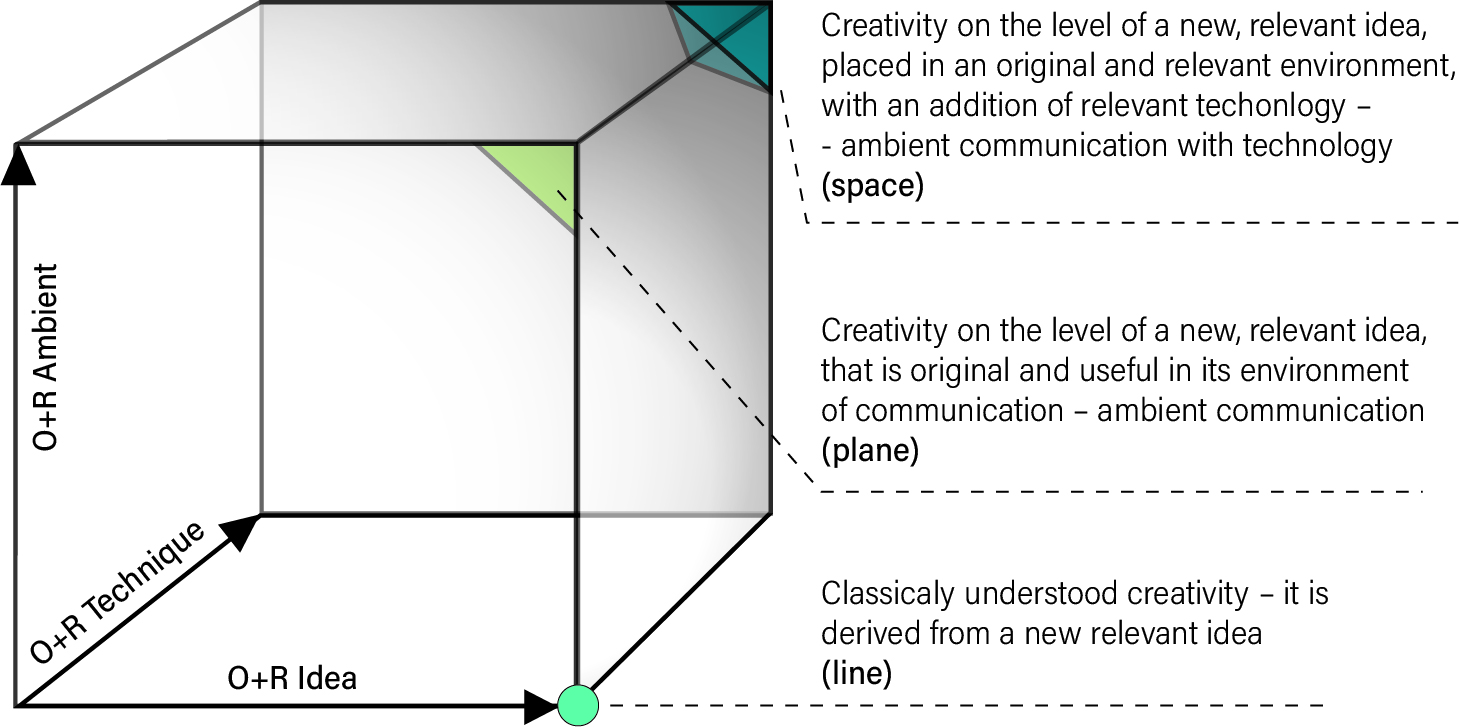
From these examples, we can deduce that thanks to the new technologies, the element of surprise and novelty have become necessary traits in ambient marketing communication and they prove creativity of new messages. Besides the first two attributes, new technologies contribute to saturation of usefulness and relevance as well. (We understand the element of surprise as a necessary aspect of creativity – Ji Han, Hanah Forbes, and Dirk Schaefer (2021)). We tried to synthesize and display the relations between all the attributes in the scheme No. 1 – this scheme follows up, elaborates on and further develops the ideas of previous authors.

Scheme No. 1: Levels of creativity of marketing communication from the point of important components of creativity with regard to new technologies and the place of ambient communication using this technology.

Legend: O = originality, novelty, unusualness, R = relevance, source: our own study.

Source: our own research

In the past, authors Roger M. Garrett (1987), Albert Rothenberga and Carl R. Hausman (1976), spoke of creativity as a vector of two basic components (aspects): originality (y axis), which would reach 45° angle with the highest possible creativity. This attitude was criticized, however, for values nearing 0° could also depict high or maximum creativity. The author therefore offered an alternative, in which the space between the lines was separated into four quadrants – and so creativity was represented only in the last one, where maximum originality meets maximum usefulness. On the other hand, in the remaining quadrants one or both of the components are under-represented, and therefore those situations are not considered to be creativity, but rather insignificant displays of failing products – with low originality or/and usefulness. Useful, but not new ideas, would not be considered nor original, nor creative. The same principle would go for bizarre new ideas that do not have any use, despite their novelty.

According to Ji Han, Hanah Forbes, and Dirk Schaefer (2021, s. 294), these relations could be expressed by the following equation:

Creativity (C) = Novelty (N) x Usefulness (U),

In other words, if a marketing message does not reach sufficient value in both Novelty (N) and Usefulness (U), it cannot be considered creative.

On a higher level, creative ambient marketing communication uses unusual placement to further deepen its originality and usefulness. If it also uses new technology, it becomes even more developed. These inclusion create new connections in new, well-integrated ambient or guerilla marketing communication (ambitechmac, ev. guertechmac)[5], and thus it reaches new level – the final part of the 3D cubic model of our scheme.

[1] According to CAGR (Compound Annual Growth Rate). The holographic display market is expected to grow at a of 27.3% over the period (2021 – 2026). Source: shorturl.at/gjnMT

[2] The campaign yielded more than a hundred thousand signatures, raising awareness of trade with wild animals and the intertwined system of organized crime.

[3] Bluejacking is using the Bluetooth technology to send spam – for example contact cards, imagery and other content – to other people’s devices without their knowledge and/or consent. Receivers of these messages are unable to identify who they the message from.

[4] Beacons are micro-devices able to connect to smart devices via the Blueetoth Low Energy technology. Within limited range, Beacons are able to send data or activate certain functions in smart devices of other people.

[5] The term ambient combined with the information about use of new technologies for the needs of marketing and/or marketing communication

Non-traditional Creativity

Non-traditional ways of propagation of products, services and ideas use unusual expressions and techniques, aiming to create unique surprise and sensation. It also reaches for new technologies, including video-tech, virtual reality and the technology of augmented reality. At the same time, one of the common forms of guerilla marketing are original poster installations (often called stickers), which can contain logo, text or illustrated materials, but especially a QR code, which takes a user to a new digital space. These are often found in public transport, at building entrances, on traffic signs for pedestrians and elsewhere in public space which are known to be frequented by a high number of people daily.

Media, which are the carriers of the message, also use new technology. They act as a middling position and mediate interaction, activating the recipient. Technologies can improve sensory aspects of the message and so deepen the experience. Technologies that interact with environment are used as an integral part of modern communication with environment (Čábyová, 2009). Among these, Bluetooth and other wireless technologies can be counted, but also the technologies that utilize motion sensors and other forms of sensory tech.

A technical example of the combination of digital technology and reality is the beamvertising. Beamvertising is a static or animated messaged projected on walls using a projector. One of beamvertising forms is called 3D-projecting, which is considered to be one of the most advanced techniques. An animated image is projected on a wall while integrating all aspects of the building’s architecture into it. Thanks to this synergy, the projected message seems to be three-dimensional, as it works with the 3D space it is exposed in.

The same principle is applied in the video-mapping, alcohol Bacardi (Daniela Krautsack,
2011, online), where we see digital mapping of urban buildings, water video-mapping, auto BMW (JCDecaux, 2012, online)., where we can see the water video-mapping technique, which projects messages on a water wall.

The following examples show a case, in which video-projection and digital technologies were used in beneficial campaigns and for charity. In a cinema in a German town called Düsseldorf, an installation was built, during which the visitors were able to experience the life of a homeless person through their sense.

The air-conditioning in the cinema brought the temperature down to 8° C, effectively mimicking the temperatures commonly experienced on the streets. At the same time, a documentary film displaying everyday lives of the homeless was played in the cinema. Visitors also received blankets with sown-in QR-codes, which served as a financial gateway for donors to use – using the QR-codes from their blankets, watchers of the documentary were able to immediately donate to the cause.  Media campaign by the Fiftyfifty organization aiming to aid the homeless. (Lum Ryan, 2013, online).

The QR-code technology is connected to the mobile tagging practice, which is another form of mobile marketing communication that enables users to access more pre-generated, ideally exclusive content through their own personal devices. Not all of this content needs to be new, since the QR-codes could for example just be gateways to websites domains, in accordance with the aims of the marketer. One of the most spectacular examples of this practice was the first anniversary of the Chinese streaming service Bilibili, which celebrated conclusion of the first year of a popular video-game called Princess Connect Re: Dive by sending out more than 1500 drones, which formed a giant QR-code in the sky in Shanghai. (Phillips, 2021). Media campaign of the Chinese streaming service Bilibili during its first anniversary. (OrTinger, ed. Roselle, 2021, online).

Perspectives of ambient marketing

Various analysis predict that atypical forms of propagation will be a huge part of the near future, as projects using ambient media strategies are noting increasing financial revenue[1]. Despite the stagnation the advertisement market went through, in 2001, ambient marketing rose by 23%[2]. Starting in 1996, when the ambient marketing approach became the topic of marketing research for the first time, this sphere has been getting much attention and it is predicted that this tendency will hold in the foreseeable future (Parikh, 2017)[3], along with the implementations of the newest digital technologies (Hagan, 2017)[4]. The newest research is not available yet, but we can conclude that the connection of marketing and the surrounding outside world will be present in the future as well – especially when we consider emerging new technologies that use augmented reality, virtual reality, various implemented bio-sensors and other tools connected to the future of media. (Lugmayr, Serral, Scherp a Mustaquim, 2013[5]). We can follow this trend as interest in new possibilities in ambient marketing is still growing, with both the clients and marketing agencies being the interested parties.

Advertisement agencies are forced to include new marketing forms that also utilize modern technologies in their portfolios. This presents a wide field for experiments that have already been explored by both the creators and their clients. When a decision to opt for an innovative approach to marketing is reached, three effects can follow:

  • The innovative campaign can result in a failure – for example when it fails to reach the target group.
  • The innovative campaign can reach a level of effectiveness comparable to classical approaches.
  • The innovative campaign will yield a significant success and prove to be a discovery of great value.

Of all of the innovative techniques, it is the ambient that has the best chance to reach the third result. That is the reason why there has been a steady increase in its utilization. Continually, the number of companies opting for ambient strategy has been rising and there is no prediction for the near future implying this trend should change, even though this approach is connected to a measure of worry associated with risks ambient techniques inherently contain.

Such doubts about ambient’s usefulness might stem from differences between generations, but also from the utilization of technology. Despite these problems, however, ambient has been more successful in reaching consumers than any other form of propagation – and not because it would be universally better, but because it is able to pique the viewer’s interest.

Another fundamental strong trait of ambient is its ability to avoid spending resources on recipients that would not react to the message. At the same time, it works with a high probability that the advertisement will get noticed, while the classical forms of marketing are actively avoided. It is impossible for a client to remain indifferent towards the ambient marketing form, as it induces emotional responses, unlike the traditionally constructed communiqués. In doing so it reaches subconsciousness and more effectively influences its recipients.

Ambient media will be more often utilized by entrepreneurs. This statement is further strengthened by the decreasing effectiveness of traditional advertisement. On the other hand, it is questionable whether such a tool, that is becoming steadily more popular, would still be categorized as ambient.

Considering the high levels of creativity and innovation of ambient marketing, it is common for classical media to also notice the ambient activities. Thanks to this, ambient advertisement is realized twice – by the non-standard activities, and by
the following publicity in classical media, which however does not have any financial costs. A useful example is the campaign of Saatchi & Saatchi from 1997, during which the Delta Air Lines built a live billboard on Times Square in New York. The billboard was a part of the Concorde airplane, including living passengers and staff. This realization was a favorite topic of American media for some time. It is in human nature to be interested in watching other people. Another example would be from the Red Square in Moscow, where there used to be an apartment in which six people lived – passersby could watch them continually through a one-way mirror.

A research conducted in association with Millward Brown from 2009 points at the significance of the new propagation form and unconventional approaches. The new prediction of the Millward Brown company from 2018 especially mentions inclusion of the newest digital and technological elements into marketing, for example the voice-controlled marketing or storytelling via personalized identification, geolocation and passive measuring.

Despite all the positives of ambient marketing, it will never supersede the standard tools of propagation communication. For various reasons, not all subjects will want to utilize ambient advertisement communication. The non-standard communication activities cannot be realized without considering the reality, thus without having a thorough understanding of the target group.

Ambient can also have another future. Many ideas connected to understanding of ambient marketing actually do not prove useful. It is possible to discover that an ambient marketing conception was so original and innovative that it cannot be used again, thus becoming absolutely unique. Another situation that might occur is that a campaign for product X will never be compatible with campaigns for product Y, even if they are from the same market segment.

Differences can be caused by little variations: a symbol, a gesture or the unique play outs of association. When these things happen, ambient itself comes the full circle, effectively strengthening the original source of traditional techniques
and tools of advertisement.

Ambient marketing can be an ideal occasional answer to the gaps of classical marketing tools with an actual inclusion of the newest technologies and communication channels. As it has become clear, effects of the ambient are best visible in symbiosis with the standard advertisement tools. K Wehleit[6] suggests the same.

In Germany, in cooperation with the German Ambient Media Association, the Media e. V, and in cooperation with a producer of the premium foods segment, an experimental research was realized. On hand, classical media were used, but in some parts of Germany, non-standard forms of marketing added to the mix – for example free-postcards, indoors marketing and street furniture[7], that Walheit did not concretize in their report. Data gathered from 2003 Germany show that connecting ambient media with the standard tools of communication reached a higher following for the campaign – 52% of respondents stated they have seen the marketing campaign in areas where the classical approach was combined with the ambient forms. On the contrary, only 18% respondents stated they have seen the campaign in areas, where only the classical marketing tools were used. Unconventional advertisement also reached better rankings for the product and the subject itself (it was liked better).

We are able to conclude that during promotion of a subject, it is optimal to connect various forms of promotion. Ambient marketing has become one of the most important forms of unconventional and alternative forms of advertisement. The result of inclusion of ambient media in traditional communication is the growth of awareness about the campaign itself, but ambient media also serve as strategic tools in time of marketing communication.

[1]      PQ Media LLC. Available at: <http://www.pqmedia.com/execsummary/DOOH09-Executive-Summary.pdf>
[2]      Marketing Charts. Available at: <http://www.marketingcharts.com/traditional/alternative-out-of-home-media-spending-soars-27-301/>
[3]      PARIKH, D. (2017) Available at: <https://www.allaboutoutdoor.com/special-feature-detail.php?category=1&mid=110>
[4]      New IFTF Report Forecasts a World of Ambient Communications (2017). Available at: <http://www.iftf.org/future-now/article-detail/new-institute-for-the-future-report-forecasts-a-world-of-ambient-communications/>
[5]      LUGMAYR, A., SERRAL, E., SCHERP, A., MUSTAQUIM, M. (2013) Ambient media today and tomorrow.
[6]       WEHLEIT, K. (2003).Ambient Media: the Key to Target Group Communication. Available at: <http://www.docshut.com/kmyqvi/ambient-media-the-key-to-target-group-communication.html>
[7]       Street furniture is a summary term for all objects installed in the streets and on roads – benches, blocking columns, mailboxes, telephone booths, lamps, traffic lights and signs, transit stops, fountains, statues… All of these offer a potentially interesting placement for marketing communiqués.

Ambient marketing and its specific principles

Based on the assumption that recipients as potential consumers direct their attention at elements in the environments that they had ignored until recently, companies place their advertisements where the recipients would not expect them and in forms the recipients would not have predicted. That is why this type of advertisement is placed at toilets, on eggs, on the thighs or foreheads of people. Ambient marketing considers every public space a potential carrier, useful for presentation. Adequately prepared ambient media have the potential to be exceptionally effective. For example, advertisements placed in toilet stalls differ from traditional ads. These exposed advertisements are impossible to ignore with regard to the situation, in which the advertisement is witnessed. It also works because it is placed in the viewpoint of the recipients with enough time for the recipient to process it. Besides, advertisements placed like this ensures a certain level of exclusivity – it is witnessed without being disturbed by other ads or stimulus. Ambient media have the potential to be successful, but adhere to a set of basic principles (Hatalska, 2008)[1].

The first basic principle is to place the advertisement close to the client, making it present in the clients’ lived environments. The company realizing such marketing steps must therefore carefully select places or points of concentration of the targeted groups, which also leads to better understanding of the target groups. The objective is to mediate the communiqué at every adequate premise, where the potential client might find themselves: in a park, on a square, in school, at a bus stop, in cinema, in sports centers, in cultural institutions.

The second principle is to integrate an original idea. In the case of the ambient media, the most important is the integral connection between the topic of the communiqué and its placement. A relevant example of such an implementation was realized by the DDB Malaysia agency, which implemented a campaign connected to global warming. The visualization created for the Regional Environmental Awareness was placed directly on the swimming pool tiles (see Picture 18). The recipient swimming in the pool might have felt like they were watching a sunken contemporary city, on top of which there was a short textual message: „Don’t let this be our future. Save our rainforest, stop global warming.”


Picture 18: Global warming


The third principle is also of high importance – to reach the consumer in with a selected adequate timing. The ideal moment works with a certain level of passivity, targeting the moment during which the recipient is not disturbed by other stimuli that could distort their attention, for example when the recipient is traveling by a tram or just relaxing on the beach. For these reasons, ambient marketing uses the outdoors forms that are perpetually integrated with the surrounding space. There is a high probability that a recipient will notice the ambient marketing form – for example, when they are waiting at a mass transit stop, when they are sitting in a traffic jam in huge agglomerations et cetera.

The final, fourth principle is calling for an emotional response. The communiqué or its message should induce a smile, be innovative and/or controversial. Spectacular, extravagant and interesting advertisement forms are easier to notice, but also more memorable. A fitting example would be the tunnel advertisement that was used for the first time in 2001 Atlanta by the Submedia World agency. It was an animation spanning over 15 to 20 seconds, which thanks to the movement of the subway train created an illusion of animation. Ambient media offer a chance to be publicly exposed and stand out from the background. They are also able to reach the potential client in a fashion that is more precise and effective. Ambient, however, requires a high measure of creativity and often serves the pioneer for new trends. At the same time, it is an advertisement form that should be able to only serve for a short time – this is usually connected to the repetition of ambient advertisement by other companies who adapt the used methods for their own campaigns (for example realizations on elevator doors, see Pictures 19 and 20).


Picture 19: A fitness center ad Picture 20: Marketing for the film Superman


When ambient advertisement becomes a trend-setter and the realization is imitated, even commonly used, it becomes a part of the standard – thus blending with usual, everyday forms of advertisement. In so doing ambient forms might transform into normal, traditional forms of marketing communication.

[1]         HATALSKA, N. (2008) Nie tylko wielka piątka, czyli ambient media i marketing szeptany jako alternatywne formy komunikacji?

Ambient marketing and its basis

We are currently living in times of information  overload, in which the quantity and diversification of available information can lead to confusion and even anxiety[1]. With the current prevalence and the so-called penetration of information-communication channels, several thousand propagation communiqués are able to reach an average recipient in a single day, and the recipient is unable to notice all of them. N. Hatalska indicates that an average recipient is able to direct their attention on maximum of 250 advertisements, and is only to remember up to about 50[2]. Naturally, this is the reason why a modern marketing company should understand that on the current market – regardless of the marketing objectives of their campaigns (raising sales, raising awareness of the brand…) – it is imperative to capture the divergent attention of the consumer (even if only on the sight-hearing level without participation of consciousness – as presented by the experts on neuromarketing[3]).

It is necessary to keep the recipient’s attention on such a level that they under the influence of the communiqué realized an activity – responded to the call to action. This task is extremely difficult, because most advertisements are published in media that are considered to be sources of entertainment by their viewers, sources of information vastly different from the contents of advertisement communiqués. Comparing levels of engagement when watching television – it would be too optimistic to expect the same kind of focus when the recipients are watching a film and when they are watching advertisement, that disturbs the film broadcast, and at the same time, this context also creates the cross-propagation problem. Repeating the message in several media brought more positive cognitive responses, improved the attitude towards the brand and helped raise the intent to buy the product more than just repeating the message in just one of the media[4].

Continually along with development of marketing and with growth of propagation communiqués, two defined groups were established among the viewers: ad avoiders and ad fatigues[5], who even try to avoid the advertisement based on location-based mobile advertising (LBA).[6] The first group consists of people who aimingly avoid advertisements, as they feel fatigued and discouraged by them. During advertisement broadcasts, they behave in a way that helps them avoid the advertisements’ influences. According to research from a university in South California, 90-95% use the time dedicated to advertisements for other activities. In Sweden, it is 84% of viewers, in Singapore, it is 69%, and in Japan, it is 66% of viewers.[7] The other group (as we mentioned in Wojciechowski, 2016[8]) – ad fatigue – does not aimingly avoid advertisement communiqués, but since it is also fatigued by the sheer quantity of information it is exposed to, the group does not pay as much attention to the content as the creators would expect. A study realized M. S. Grayson a K. Isaac[9] followed 400 participants who took part in 20 common tactics used in television and digital advertisement. Thirteen of these investigated tactics were decrypted, which was surprising even for the marketers themselves. That is why creators of advertisement today have to face the difficulty of having a more educated audience with a significant measure of awareness, an audience that trusts brands and institutions way less than the previous generations. This new audience is also able to select from a wide range of newspapers, magazines, television channels, and radio broadcast, while the perpetual growth of internet use also creates a context that is rarely comparable to the contexts of previous generations.

Research shows that a majority of consumers are overfed with advertisements. D. Burstein (2017)[10] published a research 2016 in which he lists the rankings of advertisements that respondents did not like. From all of the mentioned, the printed advertisement received the highest measure of unpopularity (9,01), followed by television advertisement (8,92), email advertisement (8,62),
and outdoors advertisement (billboards, transparents, posters) (8,35) – in outdoors advertisement, ambient advertisement was probably not included, as there is no mention of the ambient in the paper, and so we do not have its scores.

Since 1993, the Czech Marketing Association has been conducting surveys along with other subjects (in 2017, it was the Faculty of Business Administration at University of Economics and Business in Prague, POPAI CE, the Czech Association for Branded Products, and AČRA-MK). In recent years, research has been realized by the PPM Factum Research Agency (see Správa Češi a reklama, 2017)[11]. According to their findings, TV advertisement is the most unpopular (according to 64-82% of respondents), similarly to the results of D. Burstein (2017). The second most unpopular was internet advertisement (60%), printed advertisement (58%), and then  posters and billboards (48%). The Czech authors did not include ambient advertisement in their research.

A similar longitudinal research from the Slovak Republic is not known, but research of oversaturation is available, realized by P. Krnáčová a S. Benkőová (2016)[12]. In their research, YouTube advertisement was the most annoying to viewers 73% of respondents), followed by television spots (50%), advertisement in mobile applications (49%), printed advertisement (45%), and similarly to the previous research activities, this one also did not include ambient advertisement.

Recipients have a tendency to avoid advertisement, as shown by research by
P. S. Speck, M. T. Elliot (1997)[13]. This is most significant for television and printed magazine advertisement, slightly less for printed advertisement in journals, and least for advertisement in radio. This research also did not include ambient advertisement in its investigation.

As we mentioned in other parts of this publication, ambient advertisement becomes a part of the environment, it is integrated in the surroundings and brings new stimuli that can be surprising and interesting for the passersby.

According to the study of the Zenitrh company, the usage of the mobile internet service between the years 2010 and 2016 rose by 44% on average and in 2016, it presented 19% of all media consumption globally.  The study also predicted that the global consumption of media presented by internet media would reach at least 26% until 2019[14]. This data was a predictor of further reduction in effectiveness of traditional propagation methods in near future via fragmentation of the media market. A target group of adequate size that is concentrated at a single available place is of great importance to a marketing company. Such homogenous groups sharing similar traits can be found for example on beaches during the summer or skiing in the mountains during the winter. These occurrences are predictable only at specific times, as potential consumers relax actively during these seasons instead of staying at home watching television. Despite this, television still holds the highest position in marketing spending.

A significant decrease in the consumers’ trust towards marketing communiqués has also been noted. According to research realized by the Nielsen[15] company, in 2013, the highest sales potential was proven for the buzz marketing approach on 56 selected marketing. More than 84% of respondents agreed that references of other consumers (including recommenders and influencers) are the strongest factors when making a decision before making a purchase (see
Mikuláš a Světlík, 2016)[16].

Ambient communication is a partially lasting solution, as after the realization of a promotion activity in the real-life environment, documentation of the occurrence remains. These activities aim to be so unique that the resonance left by them could be observable in reports in traditional media (most often television), but also on the internet or professional, interest-focused pages, and in newspapers. Reporters, bloggers or editors in professional magazines regularly mention successful ambient activities, as they are interesting cases, something unusual that is worthy of mention, and thus spontaneous dissemination occurs. A measure of eccentricity and provocativeness of realization is an important factor. At the same time, these traits are aimed at the recipients of the media reporting on the ambient activities. The potential new consumers are also targeted, as they are prone to sharing their feelings and experiences with others, thus spreading the word and recommending the brand presenting itself by such an activity.

All of these parties are unaware multipliers, authors and co-creators of the buzz marketing effect. New data shows (see the research by Zenith[17] and data on investments in digital advertising in Europe[18]) have perpetually been adapting to the changes, resulting in growing expenses for traditional forms of propagation, but also growth of pressure on companies to develop new, better and more creative techniques, methods, and channels for spreading the advertisement communiqués. The classical advertisement, as we have known it for decades, finds itself in a certain defensive stance, even though it still holds its established position, albeit retreating from dominance. Approach to the modern, current marketing communication therefore requires significant appropriations and modifications, with a special regard to the development of technology, and especially with the knowledge of the modern attitudes of recipients. Information sharing among recipients and potential clients, the word-of-mouth phenomenon, is not a new occurrence, it has been present since the first emergence of human speech. Dialogue itself is not an incidental activity, exchange of information is genetically coded in humanity, it is a supportive mechanism useful for orientation – especially important in the current information era, the era of limitless choices.

The recipients exchange information, talk in order to reduce the possible risks, costs or insecurities connected to a purchase. Interpersonal communication in forms of discussions about products often switch to other topics, disconnected from the content of advertisement – personal life, work life, the interesting, unexpected, surprising, shocking, fear-inducing, angering, joyful things in everyday life, these are all connectible to the products and services presented by marketing activities.

Buzz marketing is not new and its roots can be followed as far as into the 1940s. In practice, however, it has been professionally used only for a few decades. The important fact, that buzz marketing is different from traditional marketing, still stands. The main characteristics of buzz marketing lies in its impossibility to precisely plan and control the progress of campaigns, as it relies on potential, voluntary, spontaneous and independent exchanges between the potential and current consumers. The main task of the advertiser in buzz marketing is to stimulate the consumers to spontaneously talk about the product, and to make communication channels available in order to enable the consumers to share information and spread the word. The advertiser, as the initial source of the buzz, cannot afford to cultivate an opponent from the recipient – it is therefore imperative to realize such activities in an ethical fashion[19].

When designing an ambient advertisement, it is necessary to always account for the possibility of a certain risk, that the whole campaign will evolve unpredictably. The reason for development of these non-standard forms of propagation communication are in big parth the consumers themselves – in this, they are called the prosumers. The term prosumers[20] is a result of convergence of the words producer and consumer, and it describes the segment of the market shared by the professional and the consumer, but also the proactive consumers themselves.

The prosumer shares their information and experiences with other consumers, for example via blogs, vlogs or via other media, but can also keep knowledge to themselves. The transformation of consumers into prosumers certainly has certainly played a part in the perpetual change of the classical advertisement’s position, retreating into a defensive. The conception first emerged in 1972 in the Take Today: The Executive as Dropout[21] publication, in which M. McLuhan and B. Nevitt suggested that with development of new electrical technologies, a consumer might more often also pose as a producer. In 1980, the term prosumer was established by Alvin Toffler along with the prediction of end for the passive character of consumption, typical for consumers.

For companies to be able to continually increase their revenues, it has been necessary to spread the word of their very existence. Companies had to present new ideas, taking a step back from the mass product, increasing the measure of customization addressed for the customers. The basic factor that enables such communication is access to new technologies along with acceptance of the new target group. Consumption acquired a new interactive character, as the prosumer is an active consumer, that collects, hoards and archives information about the topics they are interested in. Prosumers expect to have influence on the product they are selecting and expect interactive character of consumption[22], via which they would further enhance their knowledge about the product, while actively participating on the products evolution, as well as being a person that shares information about the product (or idea).

In connection to these principles, many companies are moving from informational contents of communiqués towards the more attractive forms. Increasingly often, there have been media campaigns focused on the image of the brand, often with a reminding intent. The consumer was a viewer. The prosumer is a partner.[23]

Communication with prosumers resembles a dialogue. A consumer was satisfied with an informative communiqué. On the other hand, the prosumer sees the importance of high-quality communication, which they often consider to be another form of interactive entertainment. Ambient marketing is such a form of communication with both the potential and the current client, that meets the expectations of the modern consumers who demand attractive, unusual communication that is free of templates, but even more importantly, also seems intelligent and innovative.

Regardless of which explanation of the term we accept, all of them naturally point at the activity of the consumer. That is we cannot exclude the Generation C, disconnected from the manitels of age, which was established as a term by the Nielsen company, the global leader in the field of survey, and is derived from the first letter of words like connected, communicating, content-centric, computerized, community-oriented, clicking[24] There is, however, a significant change in the behavior of the consumer. The consumer ceases to be passive and inactive. They take control and become a producer of sorts. That is the reason why it is not exceptional that when such a consumer wants to gather information, they consider more than the company itself decided to present[25]. The aforementioned of the active consumer was registered sometime around the year 2000, when the first point of the 95 from The Cluetrain Manifesto: The End of Business as Usual[26] states that the market is a conversation. The manifest[27] was written in 1999 by R. Levine, Ch. Locke, D. Searls, and
D. Weinberger. Currently, consumers have a higher measure of control, it is them who decide how a brand could be perceived, they also decide the measure of success.

The aim of every company should be to be noticed among the thousands of communiqués consumers encounter daily. A higher measure of success is reached if we focus on target groups and speak to them about their specific problems.[28] The human brain works as a filter and it filters information, which is out of the field of our perception. There are too many communiqués and the brain filters those it deems irrelevant, or irrelevant at the moment, but it keeps those it deems relevant. At the same time, if a communiqué creates an emotional response, it has a chance to reach the subconsciousness, as capturing attention is from a huge part built on emotions. Emotions are automatized processes and according to the theories of the American psychologists P. Ekman and W. V. Friesena[29], there are six basic emotions that were identified in 1972 based on a study of the Fori isolated tribe in Papua New Guinea. Based on these sex emotions, in 1980, R. Plutchik[30] built his circular diagram of emotions presenting the eight basic emotions and the eight derived emotions, of which every one consisted of two basic emotions.

People visibly react to things they know, they consider new or when they face a significant change in their lived environments. People have given much attention to topics that are scary or related to sexuality – basically, the shocking topics. Advertisements that contain disgusting imagery, sexual references, profanity and obscenity, religious taboos, vulgarity, breaches of ethics or moral decadence could be considered shocking[31]. This psycho-biological knowledge is successfully exploited by companies for design of campaigns. The aim is to capture attention of the target group, redirecting in on the product: an article, a service, an idea. Usually, these topics are related to pornography, fear, death or unusual violence. They depart from the prediction that what causes emotional reactions, that is memorable – and in that, reaching
the general objectives of advertisement.

[1]      DAVIS, N. (2011). Information overload, reloaded.
[2]      HATALSKA, N. (2008). Nie tylko wielka piątka, czyli ambient media i marketing szeptany jako alternatywne formy komunikacji?
[3]       WOŹNIAK, J. (2012). Neuromarketing 2.0. Wygraj wojnę o umysł klienta.
[4]      LIM, J. S., RI, S. Y., EGAN, B. D., BIOCCA, F. A. (2015). The cross-platform synergies of digital video advertising: Implications for cross-media campaigns in television, Internet and mobile TV Author links open overlay panel.
[5]      BRACE, I. (2007). Ad rejecters as avoiders.
[6]      SHIN, W., LIN, T. T-CH. (2016). Who avoids location-based advertising and why? Investigating the relationship between user perceptions and advertising avoidance.
[7]         BENNETT, G. et al. (2007).Lifestyles of the Ad Averse.
[8]      WOJCIECHOWSKI, L. (2016). Ambient marketing: + case studies in V4.
[9]      ISAAC, M. S., GRAYSON, K. (2017). Beyond Skepticism: Can Accessing Persuasion Knowledge Bolster Credibility?
[10]   BURSTEIN D. (2017). Advertising Chart: The types of ads consumers dislike the most (and the least).
[11]   Správa – Češi a reklama (2017). Marketing science and Inspirations.
[12]   KRNÁČOVÁ P., BENKŐOVÁ S. (2016). Spotrebiteľské správanie v kontexte online marketingu.
[13]   SPECK, P. S., ELLIOTT, M. T. (1997). Predictors of Advertising Avoidance in Print and Broadcast Media.
[14]   MEDIA CONSUMPTION FORECASTS 2016. Available at: <https://communicateonline.me/wp-content/uploads/2016/06/Media-Consumption-Forecasts-2016.pdf>
[15]   Nielsen Global Online Consumer Survey, Trust in Advertising, a global Nielsen consumer report (2013).
[16]   MIKULÁŠ, P. a SVĚTLÍK, J. (2016). Execution of Advertising and Celebrity Endorsement.

[17]   MEDIA CONSUMPTION FORECASTS 2016. Available at: <https://communicateonline.me/wp-content/uploads/2016/06/Media-Consumption-Forecasts-2016.pdf>
[18]   Dostupné na internete: <https://www.statista.com/topics/3801/advertising-industry-in-europe/>
[19]   AY, C. PINAR, A. a SINAN, N. (2010).Guerrilla marketing communication tools and ethical problems in guerilla advertising.
[20]   The term was used in the The Third Wave book by the futurologist Alvin Toffler in 1980.
[21]   MCLUHAN, M., NEVITT B. (1972).Take today; the executive as dropout.
[22]     A close relation to the web 2.0 structure has been noted. Connection, communication, content – centric, computer, community – orientation and click.
[23]     The contemporary prosumers are not just people bestowed with new tasks, but also external employees of companies that help to create  and produce the newest products and services.
[24]     FRIEDRICH, R., et al. (2010) The Rise of Generation C Implications for the World of 2020. Booz & Company Inc. Available at: <http://www.booz.com/media/uploads/Rise_Of_Generation_C.pdf>
[25]     LOCKE, C. et al. (2000) The Cluetrain Manifesto: the End of Business as Usual, Available at:: <http://www.cluetrain.com/book/index.html>
[26]   ibid.
[27]   Available at: <https://cluetrain.rovnou.cz/>
[28]   ŠKUTKOVÁ, J. (2010) Znalosť ľudskej mysle pomôže marketingu k úspechu.
[29]   EKMAN, P., FRIESEN, W. (2015) Emoce pod maskou.
[30]   PLUTCHIK, R. (1980) Emotion: Theory, research, and experience.
[31]    DAHL, D. W., FRANKENBERGER, K. D. a MANCHANDA, R. V. (2003).Does it Pay to Shock? Reactions to Shocking and Nonshocking Advertising Contents Among University Students.

Forms of guerilla marketing and their integration in space

In its essence, guerilla marketing builds on the unconventional for propagation of products, services and ideas, and as such still considered a non-standard form, despite the fact that many companies and organizations have begun using related marketing techniques. Time offset between individual projects and realizations might cause a loss of the surprising element, making the realizations seem standard and usual in their communication forms. The condition for low-cost realizations remains. Guerilla marketing uses atypical techniques, for example pretended vandalism in graffiti and writing on walls and sidewalks. It also uses original, unusually-looking posters (and/or overcharges their quantity in the so-called wild posting approach), but can also use small stickers with pictures or logos (or even just QR codes), to be placed in mass transit vehicles (subways, trains, buses…) or in entrances to buildings, on traffic signs, at crosswalks, and/or at other places typical for being crowded by a high number of potential recipients. It is a form of propagation that cannot be avoided even by the strongest opponent of advertisement. According to M. Szyszka[1], this form of advertisement could reach anyone anywhere, but, naturally, with a regard to the selected target group.

Most often, this approach is used for social issues[2], but also for cultural institutions[3], as they are typical  for their low financial costs, which is a desirable trait for many smaller institutions and organizations. At the same time, this approach to marketing does not insist on a high number of people included in its preparation.

Guerilla marketing is used to promote (or stigmatize) specific figures and life-styles. For this reason, it has been especially efficient for mediating specific attitudes or life-styles, and products connected to them, to people that could be considered resistant towards traditional forms of marketing – for example the youth.

The most spectacular realizations of guerilla marketing connect marketing activities in the offline world with the online world. In the real world, it is most commonly portrayed as street art or as an intervention, aimed at changing elements in the public spaces, making them an atypical form of advertisement and propagation. One of the noteworthy artistic examples of this initiative would be by a diverse-artistic group named Ztohoven, who besides other types of art realizes media objects, performances and advertisements. Some of the group’s activities have traits typical for the köpenickiade.[4] In 2012, the group published actual telephone numbers of the Czech parliament’s representatives, senators, members of the executives and of the president at-the-time, Václav Klaus. Another one of their medially significant activities was an activity, during which their removed the Czech presidential banner from the Prague Castle, replacing it with a piece of over-sized male underwear (male underwear).

From the marketing communication field, the campaign produced by the IKEA company could serve as an example. The company temporarily changed a bus stop, making it resemble a cozy homey room with a bed, curtains, and armchairs (installation at the Paris’ subway system). More couches placed at various locations of the Paris’ subway system, imitation of a restaurant grill, where visitors could order coffee and a breakfast menu ( Caribou Coffee), or the interactive installation of audio-emitting elements (Interactive installation, Volkswagen) are only a few examples of the modern marketing approaches, that at one hand capture the attention by their innovative form and actively include the bystanders, but on the other hand, influences the recipients without their approval or knowledge even.

As was mentioned before, this form of marketing is often used for propagation of various social actions, for example before elections (the astroturfing marketing approach being one of the possible forms), various events underlining issues of health and healthy life-styles, environmental threats or issues with social injustice.

As guerilla marketing relies on original and creative tools[5], it captures attention even for the price of crossing controversies – approach labeled as the shockvertising marketing approach. The term shockvertising comes from a combination of the shock and advertisement words. It is a form of advertisement that uses topics that could be generally considered risky, shocking, inducing mixed feelings. The aim of this form is to redirect attention towards a product, usually as a part of short-term strategy. This approach is usually thematically connected with sex, pornography, violence, disgust, fear, and the option to cross over the line of what we generally consider to be in good taste. This form of advertisement is strong for its ability to upset, attract and shock.

The main task of a shocking advertisement is to disable the possibility for a viewer’s indifference through provocation and scandal. It is a short-term, but highly intense approach, even though it does not form a standard awareness about the product (its parameters, traits, uses…). The risk of this type of advertisement lies in its capacity to cross the line and potentially damage the reputation of the brand. What is provocative for some, may be inventive and attractive to others. At the same time, the primary objective of these unusual approaches is never to offend the viewer. By trying to appeal to viewers’ sense of humor, to attack sexual, religious or moral taboos, and by other approaches, the realizers of such advertisement risk offending some of the viewers, dissuading them from taking interest in the campaigns in the future. For most cases, the risks are included in the initial costs.

Creating a scandal is an effective way to gain publicity for a relatively low cost. Sometimes, only a few posters manage to get the results. If newspapers label the campaign scandalous and the campaign faces a sort of backlash from the public, a strong value in the publicity is earned for almost no costs. For comparison, a spot in a television broadcast would cost significantly more, if it was to gain similar attention. Advertisement specialists try to capture attention no matter what, but the results of their efforts wary tremendously as the audience is bombarded with standard phrases and unconventional ideas. The worst case scenario for an advertisement is when it leaves a viewer indifferent[6].

In Barcelona, a group of activists once packaged themselves to look like meat produce available at grocery stores, labeling their own packages as human meat ( Spanish group of activists called the AnimaNaturalis posing in meat packages, Barcelona). A similar example was set by Amnesty International, which put an activist in a transparent traveling suitcase to raise awareness about the human trafficking issue (Amnesty International, the Munich airport). This shockvertising approach uses explicit imagery in public spaces to force a discussion about complicated social and ethical issues, for example the human rights, the animal rights, and many more.

For its inherent characteristics, guerilla marketing is often used in political marketing and can be used as an element of a wider marketing strategy. Among the commonly used elements of the guerilla marketing approach in political marketing, there are for example the approaches of word-of-mouth marketing, viral marketing, and ambient marketing. These elements are used to finalize the contours of wider campaigns. During the American presidential campaign in 2008
(Obama vs. McCain), imitations of dogs’ droppings were found on sidewalks to establish the connotation with McCains’ views on economic policies (McCain – Economic Policy).

If a guerilla campaign contains an element of civic engagement, its effectiveness increases. Elements of civic engagement and participation of recipients can be illustrated by the example of the political campaign before the American presidential election in 2012, during which a recipient could display their opinion by sticking their chewing gum onto a poster (US presidential election poster, 2012). Another strong visual example was set by the Amnesty International organization, who underlined the problem with the limited freedom of speech in Belarus as a result of dictatorship of the Belarusian president Lukashenko (Freedom of speech in Belarus).

[1]     SZYSZKA, M. (2013). Kształtowanie wizerunku instytucji pomocy spolecznej w mediach.
[2]     In a German cinema in Düsseldorf, there was an effort to offer mediated experiences about homeless people. The air-conditioning in the cinema was at 8°C to stimulate temperature on the streets, while a documentary about the homeless and their lives on the streets was playing. The viewers received blankets with QR codes on them, which served as gateways to donation websites, in order to address the issue. See more at: <http://www.creativeguerrillamarketing.com/guerrilla-marketing/fiftyfiftys-frozen-cinema-simulates-being-homeless-in-guerrilla-campaign/>
[3]      WALOTEK-ŚCIAŃSKA, K. (2015). Teatry publiczne w województwie śląskim a social media.
[4]      The originally German term Köpenickiade was first used to label a scandal surrounding a fake military captain from the town of Köpenick.  The objective of the köpenickiade is to use satire against bureaucrats and elites. It usually aims to raise awareness about a certain social issue.
[5]     FICHNOVÁ, K. (2013). Psychology of Creativity for Marketing Communication.
[6] On of the best-known advertisers from this area is Olivero Toscani, who published his controversial advertisements in propagation of the Benetton brand from 1982 to 2000. Most of his campaigns were institutional – based on controversial photos that only contained Bennetton’s logo. For example, the United Colors of Benetton. One of the best-known campaigns included a photo by Therese Frafe, in which there was a dying man lying in bed, surrounded by his mourning family. The controversy was set around the photo’s semblance to pictures of piety. On other posters, there were references to racism, war, religion or even capital punishment.

The place of Ambient Marketing in the wider context of Guerilla Marketing

In every previous era, the markets had experienced a time of over-saturation. The current times are not an exception, as this occurrence is present and visible right now. The overly saturated market of products and services is typical for being unaccessible to newcomers, who often struggle to capture and retain the attention of a potential customer. This is one of the reasons why the marketing experts perpetually look for new ways to popularize their products[1] or the products of their clients. Approximately, in the last twenty years, primarily abroad, but also in the states of the former eastern bloc, the approach of guerilla marketing has been gaining momentum, as its forms and dissemination waves significantly resemble viral marketing. It is based on advertisement and propagation of products, ideas and services via unconventional techniques, appropriated to the target groups.

Guerilla marketing is in its core based on the previously verified and tested marketing principles, which are now, however, adequately enriched by new supplementary, creative, and original uses. The research by A. I. Maniu and M. M. Zaharie[2] proves that the originality of the guerilla marketing approach has a significant effect on the improvement of effectiveness of communication with the target groups. The research results show, that this aspect of originality tends to be well-received, especially if the new media are also utilized[3]. At the same time, guerilla marketing improves positive attitudes towards advertisement. However,  as N. Sinan, P. Aytekin and  C. Ay[4] pointed out, it is necessary to keep in mind the ethical aspects of advertisement (especially for the advertisements that use fear-inducing tactics), to avoid loss of effectivity stemming from the non-acceptance of the advertisement from the recipients.

Guerilla marketing is dedicated especially to small and medium-sized organizations[5], even though we currently could identify such initiations even from corporations and organizations that have national, even global reach. Companies and organizations have been utilizing guerilla marketing in recent years, as they have registered its (relatively) low financial requirements for a high effectivity in propagation[6]. Various forms of guerilla marketing attract attention of clients[7]  ̶  campaigns focused on creating the moment of surprise, using presentation of new, unconventional ideas[8], or unexpected, sudden activities.[9]

Hutter and S. Hoffman (2011) therefore present the potential benefits of guerilla marketing in its financial advantages and cost-effective characteristics as two of the primary incentives for companies and organizations. (See Scheme 1.)
Scheme 1:
Idiosyncratic model according to K. Hutter and S. Hoffman (2011)[10]

The primary benefits brought by guerilla marketing stem in the principle of improved capturing of attention of potential clients and consumers. Authors of campaigns focus on creation of a surprise effect in the initial phases of their activities, using new, unconventional ideas[11]. The moment of surprise, regardless whether it is positive or negative, never leaves a viewer unaffected by what they witness, by what the communiqué encompasses. Campaigns in the ambient forms do not plan on buyin media space in the classical meaning, as they rather use the effect of new sensations.

A sensation should be spread among the widest possible auditorium with the help of recipients, who thus become multipliers for the spread. Consequently, the second phase of the diffusion effect comes. Its task is to stimulate the needs of consumers in a way that would support spread of the communiqué’s message. This system builds on the low cost effect, as the moment of surprise is mediated by the target group members, effectively reducing the costs connected to traditional marketing and its dissemination channels. These mechanisms are presented in Scheme 2.


Scheme 2:
Basic effects of guerilla marketing according to K. Hutter and S. Hoffmann (2011)[12].

The basic principle of the moment of surprise is the aforementioned capture of attention of potential consumers, using unexpected and unpredicted activities in an effort to produce the feeling of surprise[13]. This can also be used  for the sole purpose of reminding of the brand or the idea presented. Surprise itself is the difference between expectation and reality. In order to reach this result, absurdity, humor and even shock are often utilized, as it is generally rather difficult to surprise consumers of the contemporary overly saturated market. The modern consumer is better-educated and more aware of marketing efforts that are in place, and thus guerilla marketing often has to include a camouflage among its objectives – hiding the marketing aim behind the objective to create sensation.

To reach the sufficient diffusion effect, it is necessary to first reach expansion of the communicated message in order for it to become a naturally spreading occurrence among recipients, the potential clients and consumers, which is the principle on which the reduction of financial costs stands. Another aspect of reaching the expected rate of success accounts for the effect of inducing an emotional response, that would motivate the recipients to spread the message – to share their own emotional experiences with others, using the word of mouth spread channel. Diffusion effect is best stimulated via the viral marketing strategies, buzz marketing[14], which can be classified as a part of viral marketing, or through the shady practices of astroturfing marketing, in which the marketer tries to induce a false or misleading impression in order to positively affect consumers, fans and/or other recipients (this can be used for products, services, political ideas and more).

The low-cost effect is also reachable via two more strategies. The first is to initially reach a wide audience for a relatively low cost, effectively reducing the marketing cost per persona. This approach is dominant in ambush marketing, which as an approach is often labeled as malicious, parasitic and unfair. This approach often creates an artificial connection between an event and the brand, without having the brand as actual partner of the event (and this can be possibly done in a way that is legal). This practice is most commonly seen at big sports events.

Guerilla marketing strategies are connected to offensive marketing and the records indicate they first emerged on the North American market. In marketing as a whole, this method emerged in 1910, even though the term guerilla marketing was not initially used in connection to the meaning common nowadays. Since the beginning of the 20th century and up to the forties and fifties, advertisers assumed that a consumer needs to be educated and their main objective was to include the consumer in the education in a playful manner, for example by interaction. Advertisements of this era insisted on relatively elaborated texts, in comparison to today’s reduced, more professionalized contents of advertisement communiqués.

Up until the late sixties, the controversial forms of advertisement had not become common. Until then, advertisement was oriented around ordinary budgets, huge and frequented expositions, catchy jingles and visually demanding projects. It was at this time when the advertisers began to realize that their viewers had become more resistant to marketing and the classical forms of advertisement had become less effective.

The marketing sphere became ready for the evolution in the form of guerilla marketing in the late sixties of the 20th century[15]. In 1965, the first definitions of guerilla marketing connected to the transformation of the business-oriented market to the consumer-oriented market emerged. At this time, budgets for advertisement had risen, with particular focus on radio and print, thanks to which new market opportunities rose and companies had to adapt to new contexts.

The principal change in understanding of the modern market understands the necessity to investigate relationships between the company, the society, the institutions, and the competition, and extends its focus to also research activities of competitors. The classical marketing was connected to the consumed products and the tools of sales. The offensive marketing, however, implements the strategies metaphorically inspired by warfare, adapting the principles for fighting against competitors and for development of marketing communication[16]. The reason is that the term guerilla marketing itself stems from the warfare terminology, referring to partisan tactics and methods used in warfare, with a special regard to partisan troops and small, paramilitary groups that fight against the odds, and are generally out-numbered and/or have to face a huge technical disadvantage[17].

The word guerilla comes from the Spanish word guerra (and the original Latin noun werra) that means war. The word guerilla itself could be freely translated as partisan war. As such, guerilla marketing is counted among the unconventional forms of marketing, which aims to capture attention of potential clients while retaining its low financial costs. The costs themselves are relative, however, as the sizes of budgets vary tremendously, and as the huge international companies have also begun utilizing the methods of guerilla marketing, while they can invest substantial amounts of money even into strategies that should be methodically counted among the guerilla marketing forms.

In principle, however, guerilla marketing strategies should be low-cost, relatively independent from the size of the budget. The objective is to capture the attention of clients without them initially noticing they are being addressed by a marketing propagation form.

One of the adequate and well-known examples of guerilla marketing, using commotion and viral spread, was the Blair Witch Project[18]. The American film titled the Blair Witch Project (1999) belongs to the psychological horror genre. The authors of the film were absolvents of the University of Central Florida. The authors only had a very limited budget for the film (60.000 USD) and a single camera. Two of the authors created an internet campaign, which spread a fictive legend about a witch from Blair. Internet pages dedicated to the witch aimed to reach potential audiences, using narratives that often spelled information such as: “In October 1994, three students of film-making disappeared in the forest near Burkittsville, Maryland, while making a documentary film… a year later, the footage they created was found.” (Poster about the alleged disappearance).

The Blair Witch Project film globally earned almost 250 millions USD and is counted among the five most-earning horror films of all time. Marketing strategies implemented in this fashion, copying war tactics based on surprising, unpredictable fighting tactics and unexpected irregular strikes instead of classic forms of warfare, have been gradually implemented in modern marketing and marketing communication[19]. Another example could be Austrian extreme sportsman Felix Baumgartner, who alongside with the Red Bull brand set the record for the highest parachute jump in history. The campaign carried the title Red Bull Stratos and it was based on the parachutist jumping from the altitude of 39.045 km, reaching the falling velocity of 1432.8 km/h (The Red Bull Stratos Project). The important part, nevertheless, was the preparation presented by the brand and the live stream from the event. On the day of the jump, the Red Bull Stratos campaign was available for live streaming and users could follow it on YouTube, Facebook, and Twitter. On the first day alone, more than 8 million comments were posted. This campaign proves that an extraordinary event with well-prepared communication can gain millions of views, comments and interactions. At the same time, the Red Bull brand specializing in energy drinks gained on both reputation and visibility[20].

The first time the guerrilla marketing term was used with the same meaning and with the same contents, that are commonly used today, was in 1984 by Jay Conrad Levinson[21] in a book titled Guerrilla Marketing. He defined it as an unusual, unconventional form of advertisement with a low budget, which aims at conventional earnings, revenues and growth, but uses unconventional tools, for example widening of the inventory in suboptimal economic times, in order to inspire consumers and increase liquidity (Levinson 2003 )[22]. For comparison, we might consider Ives’ view (2004)[23], who defines guerilla marketing as a wide scale of advertisement methods, which try to reach people where they least expect it. Publicity stunts always capture our attention, and thus marketing experts and experts of the mainstream marketing use guerilla tactics with increasing frequency, as it is ever more difficult to reach potential consumers with traditional advertisement.

This new approach to marketing communication leans on energy, creativity and ideas. The main objective of guerilla marketing used to be enabling small companies in competition with huge corporations that possess unlimited financial capacities. Guerilla marketing activities therefore hold the basic premise: minimum effort, minimum investment, maximum efficiency.

Guerilla marketing builds on nonstandard techniques, currently more often than not utilizing modern technologies, placements and activities in real-life living conditions and at adequate times. Information about products, services and ideas presented this way spread naturally, similarly to urban legends, and in various forms of direct contact. Since the elementary trait of this form of marketing is creativity, it is required for the creators to apply their creativity in unique ways. Creativity thus becomes the only limit for guerilla marketing, more precisely, lack of creativity does – which has proven to be an unbeatable obstacle for many companies. Guerilla marketing tends to succeed in companies that are not afraid to take risks.

[1]      The product, in this case, means any result of creative activity – including ideas only.
[2]      MANIU, A.-I., ZAHARIE, M.-M. (2014). Advertising creativity – the right balance between surprise, medium and message relevance.
[3]      This might lead to the impression that this type of advertisement will be better accepted, especially by young people, who are closer to these technologies.
[4]         SINAN, N., AYTEKIN, P., AY, C. (2010). Guerrilla Marketing Communication Tools and Ethical Problems in Guerilla Advertising.
[5]         E. C. Bigat (2012) indicates that it is guerilla  marketing as a tool with low budgets that enables small and medium businesses to compete against big companies and corporations. Naturally, other opinions have emerged, for example see Z. Yuksekbilgili (2014) and his associated concluded that most of the smaller and medium Turkish firms have not utilized and do not plan on utilizing the tools of guerilla marketing in their future marketing plans.
[6]         HUTTER, K., HOFFMANN, S. (2011). Guerilla-Marketing – eine nüchterne Betrachtung einer vieldiskutierten Werbeform.
[7]      SHANKAR, A., HORTON, B. (1999). Ambient media: advertising’s new media opportunity?
[8]      CSIKSZENTMIHALYI, M. (1996). Creativity: Flow and the Psychology of Discovery and Invention.
FRANKOVÁ, E. (2011). Kreativita a inovace v organizaci.
FICHNOVÁ, K. (2013). Psychology of Creativity for Marketing Communication.
[9]         MEYER, W.-U., NIEPEL, M. (1994). Surprise.
DERBAIX, C., VANHAMME, J. (2000). The ‚you know what?‘ syndrome – how to use surprise for gaining success.
[10]   HUTTER, K. a HOFFMANN, S., (2011). Guerrilla Marketing: The Nature of the Concept and Propositions for Further Research. s. 46.
[11]     FICHNOVÁ, K. (2013). Psychology of Creativity for Marketing Communication.
FRANKOVÁ, E. (2011). Kreativita a inovace v organizaci.UNCTAD, (2004). Creative Industries and Development.
SZOBIOVÁ, E., (2004). Tvorivosť – od záhady k poznaniu. Chápanie, zisťovanie a rozvíjanie tvorivosti.
CSIKSZENTMIHALYI, M. (1996). Creativity: Flow and the Psychology of Discovery and Invention.
[12]  HUTTER, K. a HOFFMANN, S., (2011). Guerrilla Marketing: The Nature of the Concept and Propositions for Further Research. p. 42.
[13]    DERBAIX, C. a VANHAMME, J. (2000). The ‚you know what?‘ syndrome – how to use surprise for gaining success.
MEYER, W.U. a NIEPEL, M. (1994). Surprise.
[14]   HUGHES, M. (2008). Buzzmarketing: Get People to Talk About You Stuff.
[15]   During these times, the debate over the US troops fighting in Vietnam was still important, and as such, the term guerilla marketing entered the debate from the discussions about the war. Guerilla marketing strategies were connected to success in conflict. As such, the initial guerilla marketing strategies often focused on liquidation and destruction of marketing activities of competitors (especially smaller companies against huge corporations).
[16]  HESKOVÁ, M. a ŠTARCHOŇ, P. (2009). Marketingová komunikace a moderní trendy v marketingu.
[17]  The word guerilla originated in the Peninsular War (1808-1814), in which the Spanish-Portugal asymmetrical forces called the guerrilleros helped in pushing the French from the Iberian Peninsula. Throughout the history, such asymmetrical forces were also called the rebels, insurgents, partisans or just mercenaries. See: <http://www.britannica.com/EBchecked/topic/248353/guerrilla-warfare>
[18]   It was, however, not the first film to use the so-called found footage approach. The first successful experiment with the found footage that also included a beforehand prepared mystery with a big reveal was the film Cannibal Holocaust (1980, directed by Ruggero Deodato), which did not use internet marketing.
[19]  BANYÁR, M. (2011) Teoreticko-historicko-etické aspekty guerilla marketingu.
[20]   Two years of this event sponsored by Red Bull, one of Google’s top managers, Alan Eustace, beat the record by a jump from the altitude of 41.425 km (October 24th, 2012).
[21]  Levinson used to be the vice-president an advertisement agency Walter Thompson (US) and also a creative director of the Leo Burnett Advertising Europe advertisement agency. He used to give lectures about guerilla marketing at the University of California in Berkeley. He was the first author to set the theoretical basis for the guerilla marketing term.
[22]  LEVINSON, J.C (2003). Guerrilla Marketing in a Tough Economy: To succeed during an economic rough patch, you have to think and act like a successful guerrilla marketer.
[23]  IVES, N. (2004). Guerrilla campaigns are going to extremes, but will the message stick?

Specification of ambient advertisement and a proposal for systematization

The ambient marketing term includes all non-standard advertisements. If a particular advertisement is to be remembered in a wide range of advertisement materials, it is necessary for the advertisement to be uniquely creative and able to effectively use the placement space. In its forms and formats, ambient marketing is based primarily on precursored solutions and surprises by novelty. Its potential lies in interaction with the surrounding space and context, in which it emerges[1]. It reaches after the most varied communication tools, advertisement carriers, and placements, innovatively using their advantages, connecting them. Afterwards, it secondarily utilizes the benefits of the dissemination support of other media and marketing strategies[2]. The borderline meaning of the ambient marks a creative form used only once without the possibility of repetition, even though with future realizations, its value will be compared and identified with other iterations.

Ambient marketing faces various problems, for example the possibility of misunderstanding and controversy, and to an extent, even illegality. Adequately prepared, expressed and directed ambient marketing, however, has potential to be one of the strongest marketing tools available[3]. The common traits of all ambient marketing activities should be novelty, attractivity, diversion from the standards we usually see in classical marketing approaches, the element of surprise and capture of attention, that must be further retained.

In the last years, during which there have been strong trends of diversification and convergence of media and their parametric technological capabilities, as explained by H. Pravdová, (2016)[4], it is in the creators’ interest (and in their clients’ interest) to perpetually look for adequate approaches in various areas, as the old techniques and approaches register decreasing effectiveness. Tools of mass communication, as we know them in traditional forms, have lost a significant portion of their power. There are strong differences in active and passive use of the traditional media between the older and the younger generations of the recipients.

Ambient marketing uses non-traditional media, for example shopping carts, big surfaces on buildings, trash bins, street lamps, benches, and others. The main objective of an advert realized and exposed this way, in an unexpected place, is to speak to people and pique their interest. The selected position should be, however, clearly connected to the message of the advertisement, as the selection of the non-traditional marketing place should have its own reasoning, creating a complex meaning between the message and its placement. This way, the probability of success in capturing interest can be further enhanced, as it can pique media interest, and thus free media support.

A significant example of these principles is a campaign, that aimed to capture attention for a pharmaceutical product from the Jelfa company – a special pill, that should be able to reduce the effects of alcohol on an organism[5]. The realization of this campaign was referred to in 49 media, 3 of which were television reports – these media supporters, including major televisions, joined a large-scale media campaign without being aware of it. At this time, more than 7000 internet links and references emerged, while media costs of this campaign were at zero[6].

Even though these are just one-use-only kinds of realizations, connecting various types of sub-line and above-line media, they have been able to increase the efforts to create TTL (Through the Line) marketing approaches, crossing the division of sub-line and above-line activities, as their synthesis occurs naturally.

The English word ambient means surroundings or as an adjective, it describes natural conditions in the surrounding area. According to S. Luxton and L. Drummond[7], the first time the term ambient was used in the context of marketing communication was in 1996 in the Concord Advertising firm, a british agency specializing in outdoors campaigns. The name ambient became clear in its meaning after an increasing number of clients expected the agency to bring new elements that could be implemented in their campaigns. At the same time, it was necessary to create a term that would be able to unite a wide spectrum of various marketing activities under a single category.

Marketing agencies set the term for ambient communication in order to fittingly label their portfolio for efficient communication with potential clients. Clients pressed the agencies for new unusual solutions to such an extent, the agencies had to look for new placements for their advertisements. At the age of this genesis, there were places not considered for realization of advertisement communication – sidewalks, escalators, floors, elevator doors, inside doors of toilet stalls, sometimes even whole spaces or cycle paths (see Nintendo DS gaming console and Cyclepaths).

It was not possible to connect the campaigns designed this to previously existing categories, and so this new category had to emerge. Every term/label has their own etymology or genesis, and so we could use dictionaries as the first clue about their emergence. The ambiens term comes from Latin and means the surroundings. According to the Webster’s Dictionary, the word ambient is also an adjective, meaning surrounding from all sides. Cambridge Advanced Learner’s Dictionary offers a similar explanation, placed in the surrounding terrain. The Encarta World English Dictionary explains the word ambient as placed in the surrounding area. In relation to the marketing communiqués, it means that advertisements can emerge everywhere in the marked location, and it is not possible to avoid them or actively defend against them. It is assumed that the recipient will be exposed to the influence of the information contained in the advertisement communiqué in an unexpected moment, as it is not possible to avoid this advertisement as it is with the standard forms of marketing communication[8] – one could go to the cinema a bit later to avoid trailers, they could change the channel on television, refuse to take leaflets, block ads on internet websites et cetera. Consequently, such is the definition of ambient media by the Chartered Instytute of Marketing – a communication platform surrounding the consumer in their everyday lives, initially known as the lemming media, ambient media are communication platforms that surround us in our everyday lives – from the ads at gas stations to ads projected on buildings, ads on tickets to theaters, on the cricket playground or even on payrolls[9]; the term ambient media is most commonly related to the term ambient advertising. Hatalska[10] in one of the texts dedicated to non-standard forms of advertisement writes: “Ambient media are an alternative carrier, different from print, television, radio or internet. At the same time, ambient media are all non-standard actions realized via classical media and other communication channels.” Similarly, M. Węgrzyn underlines the problems of defining the term and especially the content the term ambient marketing should contain. Western authors explain the term as alternative carriers for advertisement, different from the known ones. At the same time, they are generally considered as unconventional marketing activities realized with omitting traditional media like print, television and radio[11]. M. Jurca et al.[12] the form followingly: “Ambient advertising refers to creative forms of out-of-home advertisement, mediating direct context messages via a change of element in the environment of the target group, that surprises the recipients.” We can therefore conclude that ambient marketing is a partisan type of classical outdoors marketing form, accounting with the fact that these types of advertisement are placed at unusual places, primarily in the lived environment of the target group[13]. According to J. Barnes[14], the characteristic trait of ambient advertising is to surprise the consumer with a confrontation with incongruent  stimulus placed on an unusual background. The consequenting surprise is a result of the difference between the perceived and the expected[15].

As we can see, the term is hard to define and even the experts of media houses have had troubles with it[16]. Often, outdoors activities are labeled as ambient, connecting it to the Out of Home marketing practices. Furthermore, the implementation of interesting ideas via the classical media can be labeled as such. Ambient marketing must therefore utilize unconventional  placement of provocative, but also common contents in lived environments[17], and that is why it is also possible to encounter the term street marketing in Spanish literature (Olivares, 2009)[18].

Based on these, we can conclude that ambient is based on unconventional, new and surprising ideas of execution of communication[19]. Ambient is therefore characteristic for its one-time use, individuality and the positive connotation of being borderline, placed on the periphery of marketing communication. Wożniak[20], the director of the Polish Dom Sprzedaży Mediów ARBOmedia, insists that the term presents non-standard advertisement activities that are realized in spaces where the recipients least expect it. Anna NowakowskaGodun,[21] the director of marketing at Clear Channel Poland, who focuses on outdoors marketing, thinks that ambient is the form of propagation aiming to surprise the recipient with a connection between context, atypical surroundings and unusual carriers via quantity or intensity of presence. She also underlines the importance of placement factor, realization and time aspects for execution of ambient advertisement. We can consider these to be the basic factors offering the starting points for definition presented by S. Luxton a L. Drummond[22]: „Advertisements placed at unusual and unexpected places (locations), often realized with unconventional methods (realizations), new or the first of their kind (timing).” We conclude that ambient media belong to the gallery of marketing terms that strongly avoid narrow definitions in a differentiated field of marketing communication and advertisement. Problems with differentiation and clear bordering of the term are also influenced by the fact, that underneath its meaning, there often are normal, usual activities from significantly distanced fields[23]. That is why simple drawing on sidewalks, placing advertisement on cashier  belts, changing colors of fountains of a frequented square (see The True Blood series and The Sopranos series or The Dexter series), organizing of fake manifestations or protests in the streets, or performing interesting choreographies in Flash Mobs, all of these belong to wide the family of ambient marketing techniques.

The influence of ambient on recipients is instantaneous. It creates a connection, resonates within the viewers and generates commotion with potential for a viral effect. What connects all of these activities is the fact that the medium is not only the carrier, but in itself becomes the communiqué, as according to McLuhan’s The medium is the  message[24], which is one of the fundamental dimensions of ambient advertisement.[25] Samborski[26] adds to the explanation, that ambient does not exclude any media, and as such utilizes all of the possible (and impossible) methods  and tools to reach the recipient. Ambient is an approach to advertisement, it is a way of thinking. It is the same advertisement, just more oriented towards the recipient and speaks to them where they live, eat, work, go, and seek entertainment. Ambient and sensation both impress the viewers in their home environments[27].

Ambient communication does not a priori reject any other form, but predicts the expectations of the recipient. Just like the typical outdoors marketing, ambient also uses the connection between advertisement activities and only rarely opts for individual strategy[28]. Ambient and Out-of-Home advertisements require a higher measure of creativity, as their exposition times are usually very short. These activities must also offer invention, fulfilling their roles and increasing the value of the used space, so they can leave a lasting impression[29]. Ambient media have to power to redirect the attention of viewers, forcing the to focus at unexpected realizations and their placements (Tahir, Ewing a Newton 2006)[30].  While the traditional advertisement only creates surprise by its content (for example, text or imagery of communiqués are unexpected or incongruent), the ambient media also use the ingruent element of the media itself – as it strongly contrasts with the surroundings, being surprising in the emergence itself.

Tools of ambient marketing also underline the measure of similarity in placement, realization, timing characteristics, material design or technologic support. We can therefore assume there is a certain coherence, thanks to which these techniques might be all categorized as ambient. The summary included in Scheme 3 explains it further. The scheme was published for the first time in our publication (Wojciechowski, 2016 b), but it was later revised with reflections on current case studies. Different from the previous version, in which the ambient marketing approach was categorized strictly as part of the guerilla marketing approach, the current version counts with the possibility of ambient exceeding guerilla (for example in costs, but also in disregarding other characteristics of guerilla marketing). We are aware that even this version is not a full summary and at some points, it might be insufficient in labeling all of the categories only in accordance with their respective material designs.

Scheme 3: The scheme of relations of guerilla marketing forms, revised version[31], authored design.

Ambient communication techniques have their downsides[32].  If they are displayed in a way that does not meet the viewpoint of target recipients, and their results may be impossible to measure. In order to make ambient approaches more successful, able to compete, they should meet the following requirements st by
S. Luxton a L. Drummond. It is a list of key factors that distinct ambient media from the other forms of marketing communication[33]:

  • Places stronger importance on tactics such as surprise, humor, creativity, and consequently, engagement of the audience (engaging the recipient strengthens the message, Shiffman and Kanuk, 1997)[34].
  • Enables a more significant engagement than just the out-of-home approach, and thus fewer losses. On the contrary to billboards, it avoids selective perception (meaning paying attention to advertisement from favorite brands and disregarding advertisement outside of the preferred sample), because this kind of advertisement cannot be selectively ignored (East, 1997)[35].
  • It is more intensively built on an incomplete message than the out-of-home approach. Unusuality supports interest of the consumer, thus increasing the consumer’s willingness to make cognitive effort to process the message.
  • The referential group, opinion leadership, and resonance with the target group have a higher significance – one likes the advertisement, one likes the brand – for example the word-of-mouth principle.
  • The way the consumer discovers the ambient in relation to the effectivity is of importance. Ambient partially works via mediating the surprise and creativity, but also through the consumer’s discovery that they are being spoken to. A recipient is prone to believe they have discovered something, and so the possibility to identify with the experience is strengthened. This creates a deep relationship with the target group.
  • Ambient insists on the target group that is more specific than in case of the out-of-home approach. Creators of ambient campaigns are generally young (up to 30 years old, Generation X members) and they target audiences of their age. It is considered to be generally difficult, reaching the target group of Generation X (AdNews 1999)[36], as this segment of the audience is less trusting than their parents from the generation of Baby Boomers , while they also consider themselves to be educated in media and able to see through advertisements.

Another important demarcation is the nature of connection between the consumer and the medium. Semiotics and symbols are a meaningful part of the transfer, especially in situation where lower cognitive processes take place (Fiske a Hartley, 1989)[37]. Adequately selected imagery, colors and context are able to carry meaning more effectively and faster than the text itself. In case of ambient advertisement, a symbol can be considered a medium. A symbol itself might predict innovation, sharpness, even arrogance or energy. An English company Posterscope, which includes various services from the ambient marketing approach in their portfolio, created their own authored taxonomy of localization and targeting of ambient communication[38]. This categorization is the only one we are aware of with this kind of selection process, in which the place of distribution correlates with the basic targeting of the audience, along with regard for the macro-environment (a city) with the micro-environment (a store). Authors therefore distinct between the following kinds of ambient marketing:

  • On the move: reaching the consumers on their way (advertisement on mailboxes, on gasoline pumps at stations, on television panels on city buildings, on mass transit tickets, on postcards),
  • On site: reaching the consumers in their everyday lives (advertisement on vehicles, on beer undercups, on toilet stalls, on theater tickets, at festivals, on illuminated shop vitrines, in telephone stands),
  • In connection with children: using sponsored schoolbooks, placing advertisement at amusement centers, on school trash bins,
  • In connection to stores: communicating in the area surrounding shopping centers (advertisement on shopping carts, on flooring, on shop receipts, on billboards inside the stores),
  • The strange category: including everything else that is not fitting for the other categories (huge leathery taxis, ads on bicycles, advertisement using humans, bagvertising…).


This categorization is followed by Hatalska[39], suggesting that ambient media tools should be categorized in five groups, reflecting on the way the communiqué reaches the recipient:

  • Group 1: Advertisement witnessed during commuting (advertisement on mass transit tickets, on postcards, on gas pumps at stations, on sidewalks, on surface of big entry halls at transit stations),
  • Group 2: Advertisement witnessed during entertainment (advertisement on beer undercups, on postcards in pubs, on boxes of matches, on theater tickets, on toilets, at festivals),
  • Group 3: Advertisement witnessed during learning and recreation (advertisement on school books, on trash bins and other carriers in schools, on pads for computer mice, in sports halls, at swimming pools and other recreational spaces),
  • Group 4: Advertisement witnessed during shopping (advertisement on buses, on shop flooring and outside of the shops, at places dedicated for caring for babies, on shopping carts, on shop receipts, on shopping bags),
  • Group 5: Other advertisements that are impossible to categorize among the previous (advertisement placed on bicycles, advertisement using humans, oversized mascots, laser presentations on buildings (video-mapping), on zeppelins and balloons, advertisements including actors…)

This categorization is prone to being criticized for a certain inaccuracy, as Hatalska in her second group mentions the entertainment time while she mentions the recreation time in her third group. According to us, these two categories are not sufficiently separated, and as such should not be considered disparate. Additionally, in the third group, the author connects learning with recreation, which we deem unfitting. Learning is a difficult mental activity, while recreation is, on the contrary, based on the situation of leisure, often without doing any specific activity at all. In the fourth group, the author includes the advertisement placed on buses, which we think could be counted alongside in the commuting category.

Both the Posterscope company and Hatalska establish their last categories as the most ephemeral, the final categories with everything that cannot be placed in the previous ones.

There has been an idea that non-standard creative advertisement is usually ineffective, while the effective advertisement is flat and based on cliché, even though both of this notions are easy to counter[40]. A creative and at the same time effective advertisement could be one that is not ambient and uses usual, standard and verified techniques. Many earned awards and accolades prove this, for example the categories of creative eCommerce, creative effectivity, outdoor, social influencers, creative innovations, creative data or creativity in PR campaigns along with many others (see for example the winners of the Slovak competitions Effie or Zlatý Klinec, who were definitely able to connect creativity with effectivity; but also international awards, such as Advertising Creative Circle of Great Britain, American Advertising Awards, American Advertising Federation Hall of Fame, British Television Advertising Awards, Cannes Lions International Festival of Creativity, Clio Awards, Cresta International Advertising Awards, Cristal Festival Europe, Digital Media Advertising Creative Showcase, Epica Awards, Eurobest European Advertising Festival, Galaxy Award, Golden Drum, Gunn Report, Summit Awards, The Loeries, Women’s Image Network Awards, Young Guns International Award).

Even existing research[41] confirms the relationship between the classical advertisement that is not ambient and creativity.

It still stands, however, that it is the ambient communication and ambient marketing that primarily relies on connecting  creativity of campaigns with effectivity, making this connection one of the fundamental conditions and requirements. We dare to insist that it is one of the key, determining characteristics during the integration of an installed communiqué and redefinition of used environment. That is why we can conclude that this is a completely new look at ambient advertisement that regards use of traditional media and previously untouched public space.

[1]       WILCZEK, P., FERTAK, B. (2004). Ambient media, media tradycyjne – konkurencja czy współpraca?
[2]         AZHARI, A.G., KAMEN, J. F. (1984). Study shows billboards are more effective than recall, attitude‐change scores indicate.
KING, K., TINKHAM, S. F. (1990). The learning and retention of outdoor advertising.
[3]      HATALSKA, N. (2009). Niestandardowe formy promocji.
KASZUBA, Ł. (2014). Ambient media w Polsce. Zastosowanie Ambient Mediów dla celów promocyjnych na przykładzie wybranych kampanii marketingowych w Polsce. Dostupné na internete: <http://www.slideshare.net/ukaszKaszuba/ambient-media-w-polsce>
[4]      PRAVDOVÁ, H. (2016). The convergence of traditional and internet media – challenges and pitfalls.
[5]      WOJCIECHOWSKI Ł. (2016). Guerilla marketing – Ambient.
[6]       Available at: <http://www.youtube.com/watch?v=ALOqDo5FBm0>
Available at: <http://www.youtube.com/watch?v=JJZKxYo8Q_0&feature=relmfu,>
Available at: <http://www.youtube.com/watch?v=89LFQyLy3BQ&feature=relmfu>
[7]         LUXTON, S. a DRUMMOND, L. (2000). What is this thing called ‘Ambient Advertising’?
[8]      PETRANOVÁ, D. a VRABEC, N. (2013). Persuázia a médiá.
[9]      Dostupné na internete: <http://www.cim.co.uk/Resources/JargonBuster.aspx>
[10]     HATALSKA, N. (2002). Niestandardowe formy promocji.
[11]     WĘGRZYN, M. (2002). Wyróżnić się za wszelką cenę. Dostupné na internete: <http://www.gazetaprawna.pl/dzialy/1.html?numer=846&dok=846.1.14.2.21.1.0.3.htm37>
[12]     JURCA, M. A. a PLĂIAȘ, I. (2013). Schema Congruity – A Basis For Evaluating Ambient Advertising Effectiveness.
Available at: < http://steconomiceuoradea.ro/anale/volume/2013/n1/187.pdf>
[13]     KRAUSACK, D. (2008). Ambient media-how the world is changing.
[14]     BARNES, J. (1999). Creating a difference with ambient media.
[15]     HUTTER, K. a HOFFMANN, S. (2011). Guerrilla marketing. The nature of the concept and propositions for further research.
[16]     KAŁDUNEK‐SOROCZYŃSKA, M., MAŁKOWSKA‐SZOZDA, A. a PREWĘCKA, K. (2002). Burza mózgów, czyli ambient media.
[17]     LUXTON, S. a DRUMMOND, L. (2000). What is this thing called ambient advertising?
SHANKAR, A. a HORTON, B. (1999). Ambient media – advertising’s new media opportunity?
[18]   OLIVARES, F., (2009). The advertising pollution in the cities.
[19]     PAVEL, C. a CĂTOIU, I. (2009). Unconventional advertising for unconventional media.
LEE YUEN, M. a DACKO, S. (2011). Ambient marketing – towards a modern definition.
[20]     PALUCHOWSKI, W. J. & MARCINIAK, M. (2005) Dostupné na internete: <http://yadda.icm.edu.pl/yadda/element/bwmeta1.element.ekon-element-000150326446>
[21]     PALUCHOWSKI, W. J. a MARCINIAK, M. (2005). Dostupné na internete: <http://yadda.icm.edu.pl/yadda/element/bwmeta1.element.ekon-element-000150326446>
[22]     LUXTON, S. a DRUMMOND, L. (2000). What is this thing called ambient advertising?
[23]   WILCZEK, P. a FERTAK, B. (2004). Ambient media, media tradycyjne – konkurencja czy współpraca?
[24]   MCLUHAN, M. (1967). The Medium is the Massage: An Inventory of Effects.
[25]   DAHLÉN, M., FRIBERG, L. a NILSSON, E. (2009). Long live creative media choice.
[26]   SAMBORSKI, R. (2001). Ambient – myślenie o reklamie.
[27]   HUTTER, K. a HOFFMANN, S. (2011). Guerrilla Marketing: The Nature of the Concept and Propositions for Further Research.
[28]     AZHARI, A. G. a KAMEN, J. F. (1984). Study shows billboards are more effective than recall, attitude‐change scores indicate.
[29]     KING, K. a TINKHAM, S. F. (1990). The learning and retention of outdoor advertising.
[30]   TAHIR, T. EWING, T. M., NEWTON, F. J. (2006). Using Ambient Media to Promote HIV/AIDS. Protective Behaviour Change.
[31]   A revised version of the scheme from page 38 in WOJCIECHOWSKI, L. (2016). Ambient marketing: + case studies in V4.
[32]     BHARGAVA, M. a DONTHU, N. (1999). Sales response to outdoor advertising.
[33]     LUXTON, S. a DRUMMOND, L. (2000). What is this thing called ambient advertising?
[34]     SCHIFFMAN, L. a KANUK, L. (2009). Consumer Behaviour.
[35]     EAST, R. (1997). Consumer Behaviour: Advances and Applications in Marketing.
[36]     GOODSALL, J. (1999). Ruski goes feather for leather for Mardi Gras.
[37]     HARTLEY, J. (1989). Understanding News.
[38]   Posterscope Newsletter Issue 4 (2000). Dostupné na internete: <http://www.posterscope.com/>
[39]     HATALSKA, N. (2002). Niestandardowe formy promocji.
[40]   FICHNOVÁ, K. (2007). Kreativita a marketingová komunikácia.
[41]    ibid.
KOVER, A. J., GOLDBERG, S. M. a JAMES, W. L. (1995).Creativity vs. Effectiveness?
EL-MURAD, J., a WEST, D.C. (2004). The Definition and Measurement of Creativity: What Do We Know?
KOVER, A. J., et al. (1995). Creativity vs. effectiveness? An integrating classification for advertising.