Augmented reality is a combination of the real world with a computer-generated reality using a software, imagery and a camera of an actually used device. The camera captures a real image of the physical world, the device will afterwards analyze the imagery and cover it up using the augmented reality software, adding new image or video-footage on top of the original coverage of the physical world.
Another form the augmented reality technology is the digital storefront. A shop’s window looks regularly, until a person walks by or touches the glass. The window will then use an application, that enables the bystanders to see themselves playing the guitar, for example. One of the interesting examples would be an advertisement for a soft drink which aimed to present people waiting for public transport to experience something new (augmented reality, bus-stop, advert for Pesi Max (Jacob Kasternakes, 2014)). In a bus stop glass, the bystanders were able to see improbable events take place, and the events were synchronized with the real imagery of the street the bus stop was placed in.
This kind of campaigns can also have an environmental aspect. An interactive digital project called No more fish in the? (Project Ocean, 2011, online).) can experience an immersive adventure into the underwater scenery right from their streets and they can watch their fish grow and reproduce just after they donate money to the project.
In the aforementioned examples, augmented reality was partially independent from the concrete viewer (flying UFO in the streets or watching fish being added to an aquarium after a viewer’s action). Augmented reality can be moved even further in communication and be enriched by an interactive aspect – a screen can react to a viewer directly, making him an inherent part of the production. Interactive ambient marketing – bystanders are scanned and their visages are displayed dressed in Bennetton collections (Benetton Windows Interaction, 2012, online). Bennetton Firm’s advertising reacts to concrete viewers, making them a part of the screen, displaying them as dressed in the new Bennetton collection. The element of surprise is markant for marketing communication via utilizing holograms[1], as most consumers have not yet had this kind of experience before. Hologram communication bears the elements of experience and memorability („WWF Elephant” Hologram, Watson Imogen, 2018, online). In October 2018 in selected parts of London and Edinburgh, the World Wildlife Fund started a campaign connected to a petition demanding a full stop to illegal trading with wild animals, while also increasing awareness for the problema[2].
Bluecasting is a controversial example of digital technology and a place, where an ambient marketing message is placed. It is a combination of mobile marketing communication with an external media through Bluetooth, which enables transfer of content, advertisement included. The users are therefore able to receive content (even if they do not wish it) like maps, information about cultural sites and more. This technology raises questions connected to ethics and cyber-security. Propagation via bluecasting often happens without knowledge of the user, even though recently, regulations for this practice became a bit more severe. Transfer of data without knowledge and consent of users to their devices is called Bluespam (alternatively called Bluejacking[3]) (Marchini a Tebbutt, 2007). The Beacon[4] technology can be abused in a similar way to reach same results.
From these examples, we can deduce that thanks to the new technologies, the element of surprise and novelty have become necessary traits in ambient marketing communication and they prove creativity of new messages. Besides the first two attributes, new technologies contribute to saturation of usefulness and relevance as well. (We understand the element of surprise as a necessary aspect of creativity – Ji Han, Hanah Forbes, and Dirk Schaefer (2021)). We tried to synthesize and display the relations between all the attributes in the scheme No. 1 – this scheme follows up, elaborates on and further develops the ideas of previous authors.
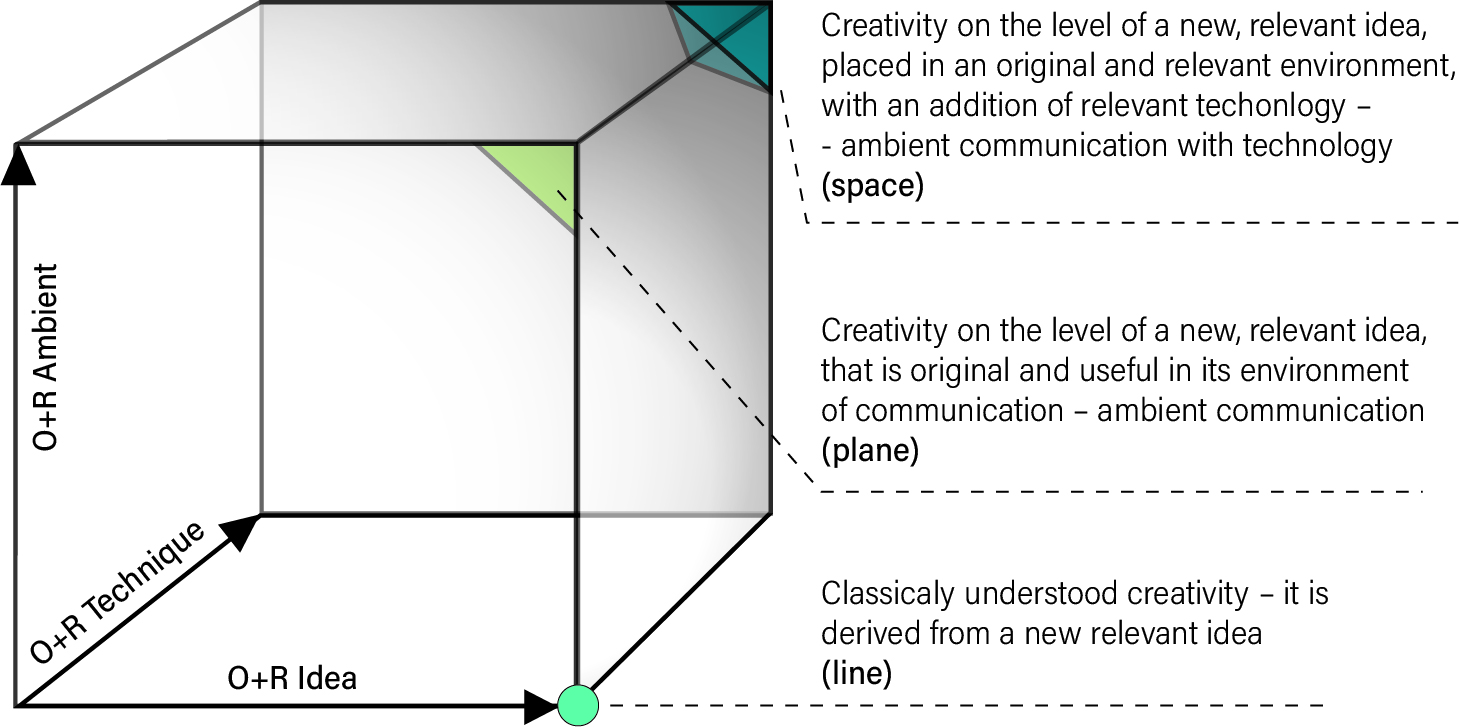
Scheme No. 1: Levels of creativity of marketing communication from the point of important components of creativity with regard to new technologies and the place of ambient communication using this technology.
Legend: O = originality, novelty, unusualness, R = relevance, source: our own study.
Source: our own research
In the past, authors Roger M. Garrett (1987), Albert Rothenberga and Carl R. Hausman (1976), spoke of creativity as a vector of two basic components (aspects): originality (y axis), which would reach 45° angle with the highest possible creativity. This attitude was criticized, however, for values nearing 0° could also depict high or maximum creativity. The author therefore offered an alternative, in which the space between the lines was separated into four quadrants – and so creativity was represented only in the last one, where maximum originality meets maximum usefulness. On the other hand, in the remaining quadrants one or both of the components are under-represented, and therefore those situations are not considered to be creativity, but rather insignificant displays of failing products – with low originality or/and usefulness. Useful, but not new ideas, would not be considered nor original, nor creative. The same principle would go for bizarre new ideas that do not have any use, despite their novelty.
According to Ji Han, Hanah Forbes, and Dirk Schaefer (2021, s. 294), these relations could be expressed by the following equation:
Creativity (C) = Novelty (N) x Usefulness (U),
In other words, if a marketing message does not reach sufficient value in both Novelty (N) and Usefulness (U), it cannot be considered creative.
On a higher level, creative ambient marketing communication uses unusual placement to further deepen its originality and usefulness. If it also uses new technology, it becomes even more developed. These inclusion create new connections in new, well-integrated ambient or guerilla marketing communication (ambitechmac, ev. guertechmac)[5], and thus it reaches new level – the final part of the 3D cubic model of our scheme.
[1] According to CAGR (Compound Annual Growth Rate). The holographic display market is expected to grow at a of 27.3% over the period (2021 – 2026). Source: shorturl.at/gjnMT
[2] The campaign yielded more than a hundred thousand signatures, raising awareness of trade with wild animals and the intertwined system of organized crime.
[3] Bluejacking is using the Bluetooth technology to send spam – for example contact cards, imagery and other content – to other people’s devices without their knowledge and/or consent. Receivers of these messages are unable to identify who they the message from.
[4] Beacons are micro-devices able to connect to smart devices via the Blueetoth Low Energy technology. Within limited range, Beacons are able to send data or activate certain functions in smart devices of other people.
[5] The term ambient combined with the information about use of new technologies for the needs of marketing and/or marketing communication